
Collaborative Governance: What It Actually Takes
Two lineages behind one term, the conditions that make shared governance hold, and the places where it breaks most often.
March 5, 2025
Updated on July 28, 2026
- The term covers two distinct practices: the multi-stakeholder policy forums studied by Ansell and Gash, and shared governance inside a single organisation.
- Six conditions make shared governance hold: written roles, a decision rule, a slot where structure changes, an upward link, a mandated facilitator, and a readable decision record.
- Power imbalance, the facilitator's own influence, and silence mistaken for agreement are the three flaws practitioners document themselves.
- Gradual adoption holds better than a company-wide switch, and some decisions stay legally outside the circle.
The Sacramento Water Forum is one of the most studied cases of collaborative governance anywhere. The city and county of Sacramento opened negotiations in 1993. Forty agencies and businesses signed the agreement in 2000, after seven years and thousands of hours of meetings.
Seven years is the number the best-practice listicles never mention, because they are talking about something else without saying so. The phrase "collaborative governance" covers two distinct practices, and blurring them produces the kind of advice that costs nothing to write and changes nothing once applied. "Improve communication" and "set clear objectives" hold for any organisation, which means they hold for none in particular.
Here are the two lineages, the conditions that make shared governance hold inside a company or a nonprofit, and the exact places where it breaks.
Two lineages behind one term
The public policy lineage
Chris Ansell and Alison Gash, both at UC Berkeley, published a meta-analysis of 137 cases in the Journal of Public Administration Research and Theory in 2008. Their definition is narrow. Collaborative governance is an arrangement where one or more public agencies directly engage non-state stakeholders in a collective decision-making process that is formal, consensus-oriented and deliberative.
Their model isolates the variables that decide how these forums end. Prior history of conflict or cooperation weighs from the start, and so do power and resource imbalances. Institutional design and facilitative leadership come next. The process itself runs as a loop of face-to-face dialogue, trust that builds, commitment to the process, and shared understanding that forms. Virtuous cycles start when the forum lands small wins early enough for trust to set.
Elinor Ostrom reached the same place by another route. In Governing the Commons (1990), the book that earned her the Nobel Prize in Economics in 2009, she derived eight design principles for institutions that manage a shared resource over the long run. The third one carries the argument: most individuals affected by the operational rules can take part in modifying those rules. The eighth describes nested enterprises, where monitoring, sanctions and conflict resolution are organised in successive layers.
The organisational lineage
Gerard Endenburg installed the same idea in an industrial SME from 1970 onward, at Endenburg Elektrotechniek. The sociocracy that came out of it rests on four principles: consent, the circle, the double link and election without candidates. Brian Robertson took that base and tightened it from 2007 in holacracy, with a written constitution that fixes the objection criteria and the exact meeting sequence.
Ostrom's third principle and Endenburg's consent say the same thing in two vocabularies. Sociocracy's nested circles match the nested enterprises of the eighth principle almost line for line. Both lineages answer one question: how do you decide together without one person ruling for everyone, and without the group grinding to a halt.
What actually separates them
Cost. Sacramento negotiated for seven years because the parties shared no employer, no purpose and no ability to walk away. A circle of eight people inside a company has all three. A governance meeting therefore closes in ninety minutes what a multi-stakeholder forum takes years to settle.
Advice written for one transfers badly to the other. Recommending "structured stakeholder forums" to a team of twelve makes them pay the price of a problem they do not have.
Six conditions, and what breaks without them
Written roles, each with a domain you decide alone
A role carries a purpose, a domain where whoever holds it decides without asking, and accountabilities the others expect from it. One person holds several roles, and a role changes when the need changes. That is the whole difference with a job description, and the article on defining roles gives the writing template.
Without that writing, authority distributes itself by seniority, friendship and comfort with speaking up. Jo Freeman described it in 1972 in The Tyranny of Structurelessness. An organisation that removes its official structure immediately grows an unofficial one that nobody elected and nobody can challenge. It is the first reason liberated company initiatives fail.
A decision rule that closes the subject
Consent decision-making asks a different question. It asks whether a reasoned objection remains rather than whether everyone agrees, which moves the burden of proof onto whoever blocks. Holacracy goes further and requires four cumulative criteria before a concern counts as an objection.
Without a written rule, two outcomes show up and both are expensive. The group chases everyone's agreement, and the same discussion returns meeting after meeting. Or the founder decides at the end, which makes the preceding discussion decorative and teaches the team that its time is being wasted.
A slot where the structure changes
The governance meeting handles structure and nothing else: creating a role, amending another, setting a policy, filling an elected seat. Work in progress belongs somewhere else, in the tactical meeting.
Without a reserved slot, operational urgency wins every trade-off and the org chart falls a year behind the actual work. A role that has been badly defined for a month had already been badly defined for six.
A link that runs upward
Sociocracy's double link seats two people in both circles. The operational leader carries the parent circle's voice into the child circle, and the elected delegate carries the child circle's voice into the parent circle, with the right to consent in both.
Without the second link, the parent circle sets the rules that apply to the child circle on its own. What you get then has the vocabulary of circles and the behaviour of a hierarchy. Most introductions to sociocracy skip past this exact point.
A facilitator with a mandate to cut people off
The facilitator stops reactions during clarifying questions, holds the rounds one person at a time, and tests objections. That mandate is granted explicitly, in front of everyone.
Without it, the rounds collapse into open discussion by the second session, and the objection round becomes a preference round with a more flattering vocabulary.
A decision record people can read
Every decision is logged with its date, its scope and its review date. The record belongs to the role concerned and stays readable for whoever arrives later.
Without it, the same debate resurfaces every six months, nobody remembers the reason that settled it, and a new joiner spends a year working out why things run the way they do.
What breaks anyway
Seating everyone in a circle leaves the power imbalance intact. Ansell and Gash rank it among the most decisive starting conditions across their 137 cases, and their answer lies in institutional design and facilitative leadership rather than in the goodwill of participants.
The facilitator holds more influence than the role advertises. They rephrase proposals, they judge an objection to be resolved, they pick the moment for the round. Jem Bendell, the British academic who founded the Deep Adaptation Forum, calls this the framing effect, where you steer a decision while keeping the appearance of neutrality. Rotating the role and writing proposals before the session reduce the exposure.
Meeting time climbs with the number of participants. Six rounds among six people fit in twenty minutes, while the same proposal among twenty people fills half a day. That is precisely why sociocracy works in small linked circles. Buurtzorg, the Dutch home care network founded in 2006 by Jos de Blok, runs some 14,000 nurses in teams of at most twelve.
Silence passes for agreement. Sociocracy For All states plainly that absence of objection gets confused with consent, and that the confusion turns harmful in a group where a few people dominate. A team coming out of ten years of top-down management needs time before it feels allowed to block the group.
The procedure can become the subject. Bendell describes groups that spend more energy checking they are applying the method correctly than handling the problem in front of them. The symptom shows early, when meetings start being about meetings.
The load rises while the resources stay flat. The study by Thierry Weil and Anne-Sophie Dubey for La Fabrique de l'industrie, published in 2020 as Au-delà de l'entreprise libérée, covers ten organisations of 50 to 1,300 employees and lists the observed effects: responsibility that exhausts people over time, rising psychosocial risk, and transparency that slides into peer surveillance.
Some decisions stay outside the circle. In France, the employer remains legally responsible for hiring, pay, sanctions and dismissal. A circle can prepare those subjects, inform them and recommend a direction, and the final call escapes it. Most European jurisdictions draw a comparable line.
A company-wide switch fails more often than gradual adoption. Zappos lost 18% of its headcount in 2015 after imposing holacracy on 1,500 people. Bol.com started the same year with two volunteer logistics teams and still practises its model. Ethan Bernstein, John Bunch, Niko Canner and Michael Lee concluded in Harvard Business Review in 2016 that it works better to borrow self-management mechanisms where adaptability matters most and keep a conventional setup where reliability matters most.
What collaborative governance does not fix
It distributes decision authority, and it stops there. It produces neither the strategy, nor the technical skill, nor the order book. An organisation that decides better also reaches its bad decisions faster.
It says nothing about pay or about evaluating people either. The holacracy constitution leaves both subjects entirely aside, which surprises many teams who hoped to find an answer there.
Of course, these limits make it a less spectacular project than advertised. They also make it a doable one: writing fifteen roles and one decision rule takes two workshops, whereas "changing the culture" never gets done at all.
Where to start
- Map what already exists before changing anything. Writing down the roles people actually hold surfaces accountabilities nobody carries and subjects three people each believe they own.
- Name what stays closed: safety, client commitments, budget, legal obligations. Saying clearly what does not open is what makes the rest credible.
- Pick a single team as the pilot and give it a written decision domain.
- Set the decision rule and apply it to a real subject in the first week. A rule tested on a fictional subject teaches nobody anything.
- Open a monthly ninety-minute governance meeting, with a facilitator who has the mandate to cut people off.
- Log every decision with its review date. A decision without a review turns back into a frozen rule, exactly what the whole effort was meant to avoid.
The guide on raising a tension shows how an everyday annoyance becomes a proposal, and the one on running your first meeting walks through the full sequence.
Running shared governance in Rolebase
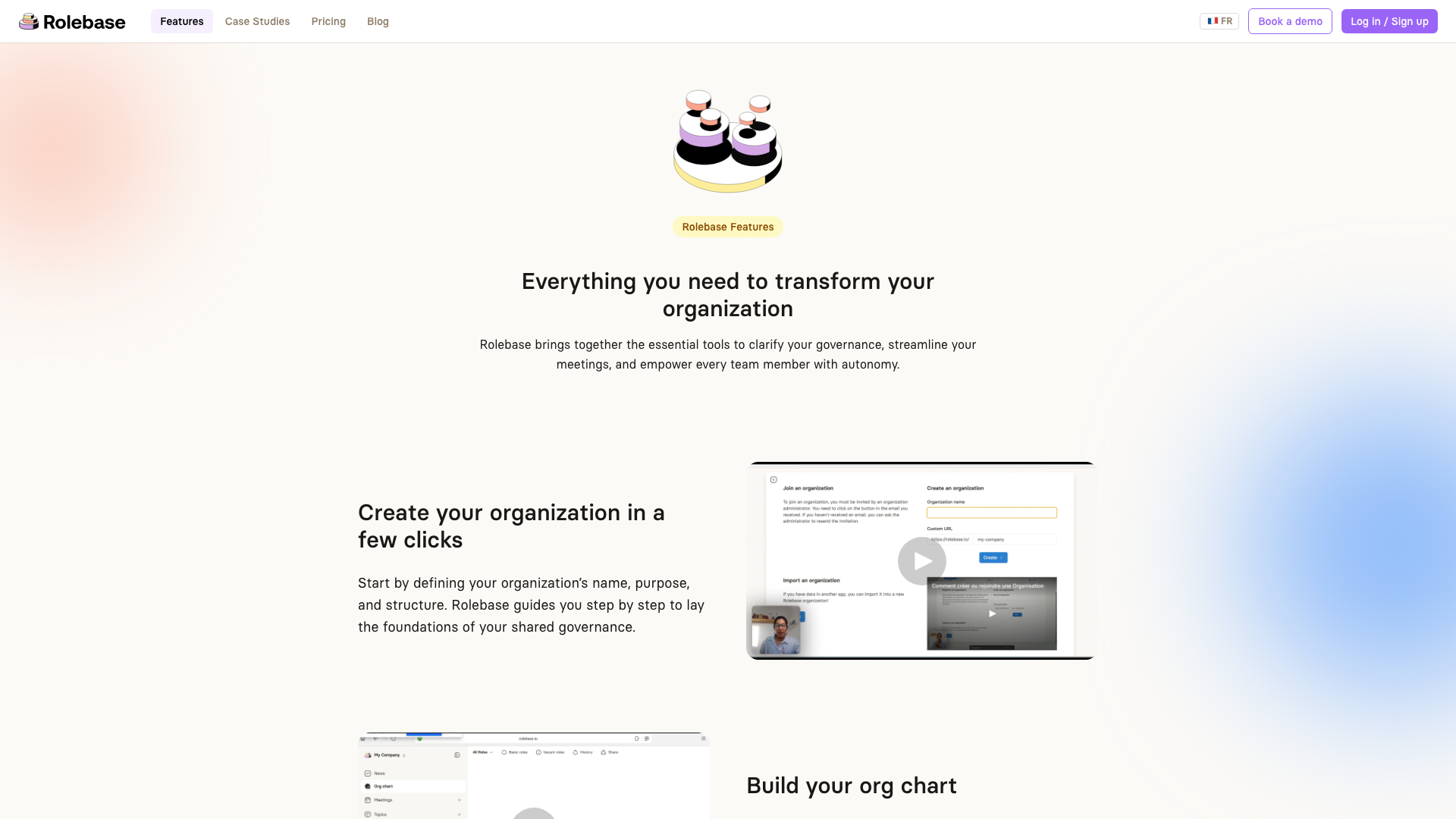
Rolebase gives each of the six conditions above a place to live. The org chart is navigated visually and every role carries its purpose, its domain, its accountabilities, its checklist and its indicators. A role can be marked as representing its parent role, which makes the double link concrete.
Proposals are voted by consent, unanimity, simple majority or absolute majority, and they carry org chart changes that stay pending until approval. Each adopted decision lands in the record of the role it belongs to. The three governance modes determine who edits the structure directly and who has to go through a proposal. Meetings are built from steps you order yourself, replay identically through templates, and sync with your calendar.
The worker cooperative EVEA shows the tipping point. The company went from 60 people in 2020 to 140 in 2023 across three sites, with shared governance already in place. What was missing was the map: a hand-maintained slide deck had stopped keeping up.
Explore the Rolebase features, or create your organisation free for up to five active members.
Frequently asked questions
What is collaborative governance?
The term covers two neighbouring practices. In public policy, Chris Ansell and Alison Gash defined it in 2008 as an arrangement where one or more public agencies directly engage non-state stakeholders in a collective decision-making process that is formal, consensus-oriented and deliberative. Inside an organisation, it means distributing decision authority across written roles, with an explicit rule for settling whatever exceeds a single role. Both rest on the principle Elinor Ostrom stated back in 1990: the people affected by a rule take part in changing it.
What is the difference between collaborative governance and shared governance?
The two expressions overlap heavily in practice. "Shared governance" is used mostly for organisations that distribute authority internally, with sociocracy and holacracy as the reference frameworks. "Collaborative governance" also translates the academic term from public policy research, which describes forums between separate stakeholder groups. Context usually resolves the ambiguity. In US higher education, "shared governance" carries a third meaning about faculty participation in university decisions.
Do you have to adopt sociocracy or holacracy to start?
No. Sociocracy 3.0 was designed precisely to avoid that gate, by splitting the practices into patterns you can adopt one at a time. A team can write its roles and hold a monthly governance meeting without ratifying any constitution. Four researchers writing in Harvard Business Review in 2016 concluded that partial adoption gives better results than taking on a whole model at once.
Does collaborative governance slow decisions down?
It slows them down when you apply it to everything. Consent is fast on structural decisions in a small group and slow everywhere else: six rounds among six people fit in twenty minutes, while the same proposal among twenty people fills half a day. That is why holacracy reserves consent for governance and gives each role holder the authority to decide alone within their domain. A team that puts the choice of a supplier through a consent round manufactures the very slowness it blamed consensus for.
Which decisions stay outside the collective?
In France, the employer remains legally responsible for hiring, pay, sanctions and dismissal whatever governance is in place, and most European jurisdictions draw a similar line. Contractual commitments to clients and safety obligations belong to the same category. A circle can prepare those subjects and recommend a direction, and the final call belongs to the employer. Naming these zones from the start is what makes the autonomy granted elsewhere credible.
What to take away
Collaborative governance is judged on what is written down rather than on what is felt. A multi-stakeholder forum like Sacramento took seven years to produce an agreement signed by forty organisations. A team of twelve gets the equivalent at its own scale in a few months, provided it writes down its roles, its decision rule, and the slot where the structure evolves.
What holds in both cases fits into one sentence Jo Freeman wrote more than fifty years ago. Removing an official structure does not remove power, it only makes it invisible. The useful question is about what you put in its place.


