
Roles vs Job Descriptions: What Each One Is For
A job description serves the contract and the hiring process. A role describes the actual work. Where the line sits, and how to run both.
April 15, 2025
Updated on July 28, 2026
- A job description belongs to a person and an employment relationship. A role belongs to the organization and describes a piece of work.
- A role carries a purpose, a domain it decides on alone, and accountabilities other roles expect from it.
- Job descriptions still do four jobs well: hiring, grading and pay, compliance, and evidence in a dispute.
- Changing a role changes the org chart. Changing pay, grade or hours changes the contract, and those stay separate.
Open a developer's job description written three years ago. It says "participates in code reviews", "maintains technical documentation", "provides tier 2 support". Now ask her what she actually did last week. She onboarded two new hires, settled a hosting decision, and ran the team's weekly. None of it appears in the document.
The World Economic Forum's Future of Jobs Report 2025, built on responses from more than a thousand employers, puts it plainly: 39% of the key skills the labour market expects will have changed by 2030. A document written once at hire and reread at the annual review does not keep up with that.
The tempting conclusion is to throw job descriptions away. That conclusion is wrong, and in a few jurisdictions it is expensive. A job description and a role answer two different questions. One describes an employment relationship attached to a person. The other describes work attached to the organization. Teams that get this right write both, and stop asking the job description to do a job it was never built for.
What a job description actually does in law
In the United States, nothing requires an employer to write job descriptions at all. The ADA regulations at 29 CFR 1630.2(n)(3) make a written job description one of several pieces of evidence of a job's essential functions, and the weight it carries depends on when it was written. A description prepared before advertising or interviewing counts. One revised after a dispute starts counts for much less.
Job titles carry even less weight. The Department of Labor's guidance on the FLSA white-collar exemptions is explicit that job titles do not determine exempt status, and that an employee's actual duties and salary decide it. A person's classification rests on what they do, which is precisely what a stale job description fails to record.
In the United Kingdom, section 1 of the Employment Rights Act 1996 requires a written statement of employment particulars that includes the job title or a brief description of the work. Since 6 April 2020 it is a day-one right and it extends to workers, not only employees. This is a short written statement rather than a full job description, and it is mandatory.
France goes further in the public sector. A 2014 decree makes the annual professional interview compulsory for local-government staff and requires the job description to accompany the invitation, so the document itself is legally required there.
The practical rule fits in one line. The employment contract and the statutory statement stay exactly where they are, and roles sit on a different plane: the work to be done, and who decides what.
A collective agreement, a union contract or a public-sector framework may require a job title, a grade or a written job description. Read it before rewriting your documents. Roles describe the work, and grading and contracts keep running alongside.
What a role contains
The Holacracy constitution, in version 5.0, defines a role through three elements: a purpose, one or more domains, and one or more accountabilities. The purpose names the potential the role pursues. The domain names what the role controls exclusively. The accountabilities name the ongoing activities other roles expect from it.
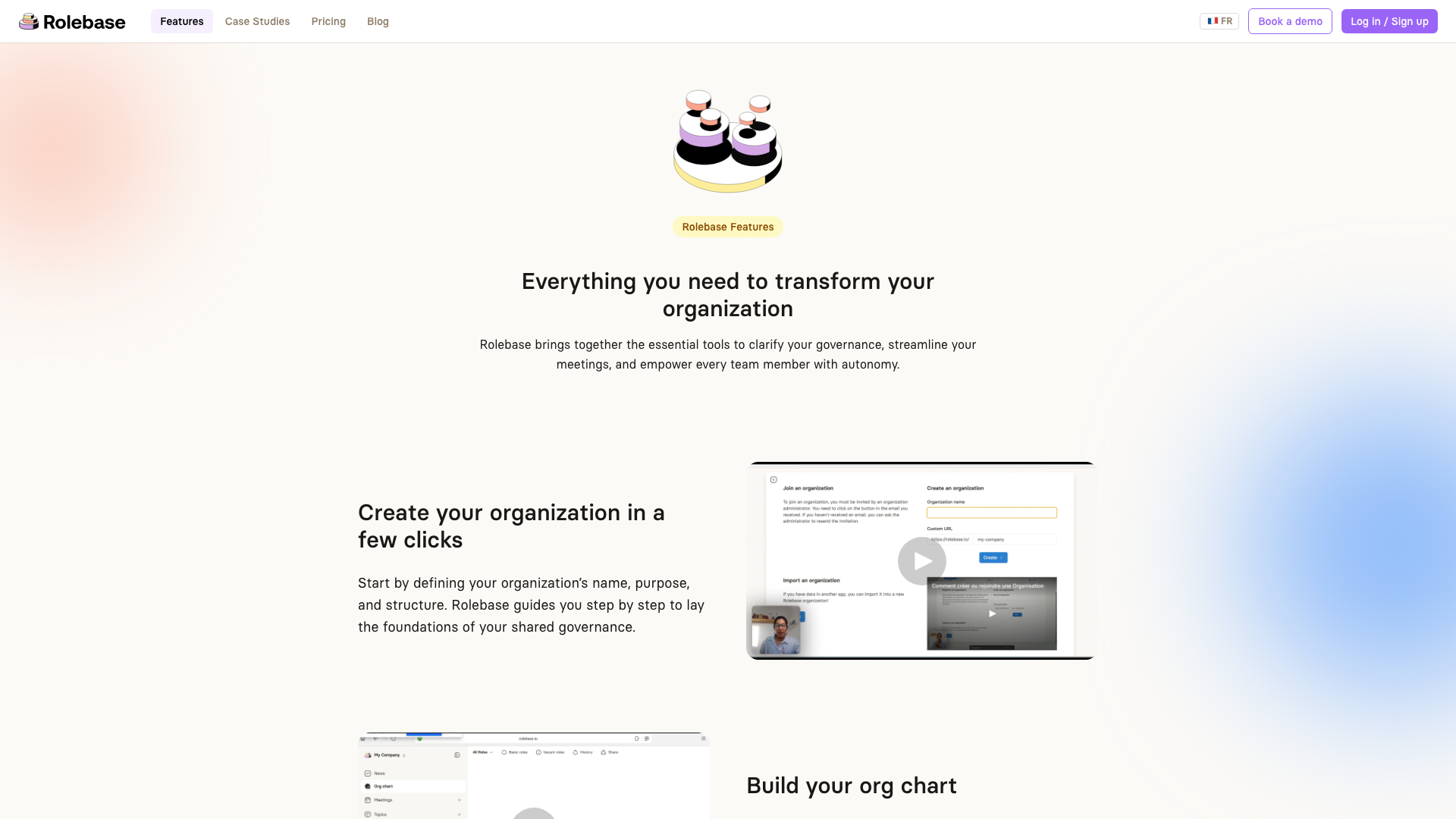
Rolebase keeps those three fields and adds three more: a checklist, indicators and notes. A role becomes a team as soon as you nest sub-roles under it, with no separate entity to create. The documentation on roles covers the model, and our guide to writing roles covers the wording.
One job description, three roles
Here is the kind of extract you find in a forty-person company.
Communications Officer. Reports to: Marketing Director. Responsibilities: build and run the communications plan, manage social media, write print and web copy, organise events, handle press relations, contribute to employer branding. Required skills: Adobe suite, excellent writing, strong organisational sense.
The document says who the person reports to and what she is good at. It leaves two questions open. Who decides when two teams both want the same publication slot? And what happens to this territory the day she leaves?
The same work written as roles looks like this.
| Role | Purpose | Domain | Accountabilities |
|---|---|---|---|
| Social Media | An audience that recognises our voice and comes back on its own | The official accounts and the publication calendar | Publishing to the calendar. Replying to comments within 24 hours. Presenting the month's reach to the team. |
| Press | Journalists who call us before they write about our market | The press list and official statements to media | Keeping the list current. Briefing spokespeople before every interview. Answering enquiries within 48 hours. |
| Events | Visitors who leave a trade show with a reason to call us back | The events budget and the choice of trade shows | Setting the year's programme. Coordinating logistics. Writing up each event within fifteen days. |
The domain settles the question in advance. Who owns the publication calendar? The Social Media role does, in writing, and the question stops travelling up to the Marketing Director.
The accountabilities can be checked. "Excellent writing" is arguable forever. "Replying to comments within 24 hours" is one page-load away from being verified.
The three roles can be split. One person can hold all three, or two while someone else picks up the third. On the day she leaves, you know exactly what falls vacant and what stays covered. Rolebase lists those vacant roles, the ones nobody holds. That is the question a stack of job descriptions never asks: which work is written down and carried by no one?
What changes when the role becomes the unit
One person holds several roles, and one role can be held by several people. You can also reserve a role for a single member when the work demands it.
A role changes without touching the contract. Amending an accountability happens in the org chart. Changing pay, grade or hours goes through the contract. Keeping the two planes apart stops an organizational clarification from queuing behind an HR process.
The written role earns its keep every week. When you create a meeting in Rolebase, the role's checklist and indicators are copied into the matching agenda steps. A role reread in a meeting stays alive. A role nobody opens turns back into a job description under a new name.
Who may edit a role depends on the governance mode you pick. In free mode, every member edits the whole org chart. In agile mode, the person responsible for the role decides. In strict mode, every structural change goes through a proposal, as in Holacracy.
Rickover, and the limit of the exercise
Admiral Hyman Rickover ran the US Navy's nuclear propulsion programme for more than thirty years. In his address Doing a Job, delivered at Columbia's engineering school in November 1981, he described his method:
In my organization, there are no formal job descriptions or organization charts. Responsibilities are defined in a general way, so that people are not circumscribed. All are permitted to do as they think best and to go to anyone and anywhere for help. Each person then is limited only by his own ability.
Rickover also hand-picked his engineers, interviewed every one of them personally, and knew his organization line by line. Few leaders work under those conditions. What his sentence targets is the document that boxes people in, the list of twenty tasks that becomes a ceiling. A purpose, a domain and three accountabilities say what is expected and leave the how open. That is the opposite of a ceiling.
When the job description is still the right tool
Hiring needs one. A job advert is a job description, and a candidate expects a title, a level, a pay range, a location and a contract type. A role carries the work and leaves all of that out.
Grading and pay need one. Salary bands, union scales and public-sector grades all reason in jobs and levels. A role map works alongside them rather than replacing them.
Disputes need one. In a discrimination or classification case, the written job description is what a regulator or a court reads, and under the ADA it only counts if it existed before the hiring process.
Compliance needs one. Statutory written statements, public-sector rules and safety-critical or licensed positions all require a document attached to a named person.
The split is simple. The contract and the job description describe an employment relationship. Roles describe the organization's work. Teams that last keep both and know which one answers which question.
Three objections worth taking seriously
"We just moved the paperwork." Fair, when nobody rereads the roles. A role unchanged for eighteen months describes either perfectly stable work or a document nobody opens. The governance meeting exists for this: create a role, amend another, work through a tension about how the team operates.
"People end up with fifteen roles." It happens, and it is a sign the work has been sliced too thin. A role fits on one screen and can be told in a sentence. Someone holding fifteen roles is really holding one, cut fifteen ways.
"Managers lose something." They do. Part of their arbitration power moves into role domains. Thierry Weil and Anne-Sophie Dubey describe the effect in Au-delà de l'entreprise libérée (La Fabrique de l'industrie, 2020): managers are sometimes held responsible for matters on which they no longer have decision power or information. Writing the managers' own roles first, with their real domain, spares them that gap.
Where to start
- Write down the roles people already hold, before changing anything. The exercise surfaces accountabilities nobody carries and topics three people each believe they own.
- Take one team and one job description. Cut it into roles, each with a one-sentence purpose, a domain, and three accountabilities at most.
- Name the holders, and leave the vacant roles visible.
- Open a monthly meeting where roles evolve. Contracts and job descriptions stay untouched until the employment relationship itself changes.
The Role Based Management article places the method in its wider frame.
Frequently asked questions
Are employers required to write job descriptions?
In the United States, no. The ADA does not require employers to create or maintain job descriptions, though 29 CFR 1630.2(n)(3) treats a description written before advertising or interviewing as evidence of a job's essential functions. In the United Kingdom, section 1 of the Employment Rights Act 1996 requires a written statement of particulars including the job title or a brief description of the work, as a day-one right since 6 April 2020. In the French public sector, a 2014 decree requires the job description to accompany the invitation to the annual professional interview. Collective agreements and union contracts can add their own requirements.
What is the difference between a role and a job description?
A job description describes an employment relationship attached to a person: title, reporting line, responsibilities, required skills. A role describes work attached to the organization: a purpose, a domain it decides on alone, and accountabilities other roles expect from it. One person holds several roles, one role can be held by several people, and roles change at the pace of the work rather than at the pace of HR cycles.
Can we drop job descriptions entirely and keep only roles?
Not entirely. Job descriptions keep four uses that roles do not cover: writing a job advert with a title, level and pay range, anchoring a position in a grading or salary structure, meeting statutory and licensing requirements, and standing as evidence of assigned duties in a dispute. Organizations that move to roles usually keep one short job description per person alongside a detailed role map.
Does changing a role require a contract amendment?
Changing a purpose, a domain or an accountability is a matter of work organization and needs no amendment. An amendment becomes necessary when the change touches the contract itself: pay, grade, hours, or the substance of the position the person was hired for. Stripping someone of every responsibility matching their grade is a contractual change whatever vocabulary you use for it, and local employment law decides that, not the role map.
How many roles can one person hold?
There is no fixed number. The signal to watch is readability: each role fits on one screen and can be told in a sentence, and the holder can say what is expected of them on each one. Ten or fifteen roles per person usually means the work has been sliced too thin, with several roles describing what is really a single responsibility.
What to take away
Job descriptions were never designed to describe the actual work of a team that moves. They hire, they grade, they satisfy regulators, and they hold up in a dispute, and they do those four things well. Asking them on top of that to say who decides what, week after week, is asking for a trade they never learned.
Roles answer that question. A purpose, a domain, accountabilities, reread in meetings and editable without a trip through legal. That is what Rolebase makes concrete: a living org chart where every role carries its own definition, indicators and members, and where the vacant ones are visible. Create your organization free for up to five active members.


