
Best Alternative to Talkspirit in 2026
Open-source, affordable, and built for self-managed teams: discover why organizations are switching from Holaspirit to Rolebase.
March 27, 2026
Updated on October 13, 2026
If you're reading this, you've probably used Holaspirit (now part of Talkspirit) or you're evaluating governance tools for your self-managed organization. Maybe you've noticed that Holaspirit's identity has shifted since it was absorbed into Talkspirit, or that pricing has become harder to understand, or that certain features you need are locked behind enterprise plans. Whatever the reason, you're looking for an alternative that fits your team better.
Rolebase is an open-source governance platform built specifically for organizations practicing Holacracy, Sociocracy, or any form of shared governance. It offers structured meetings, clear role definitions, async decision-making, and a transparent org chart, with a generous free tier and full source code transparency.
Let's take a closer look at why teams are exploring alternatives and how Rolebase compares.
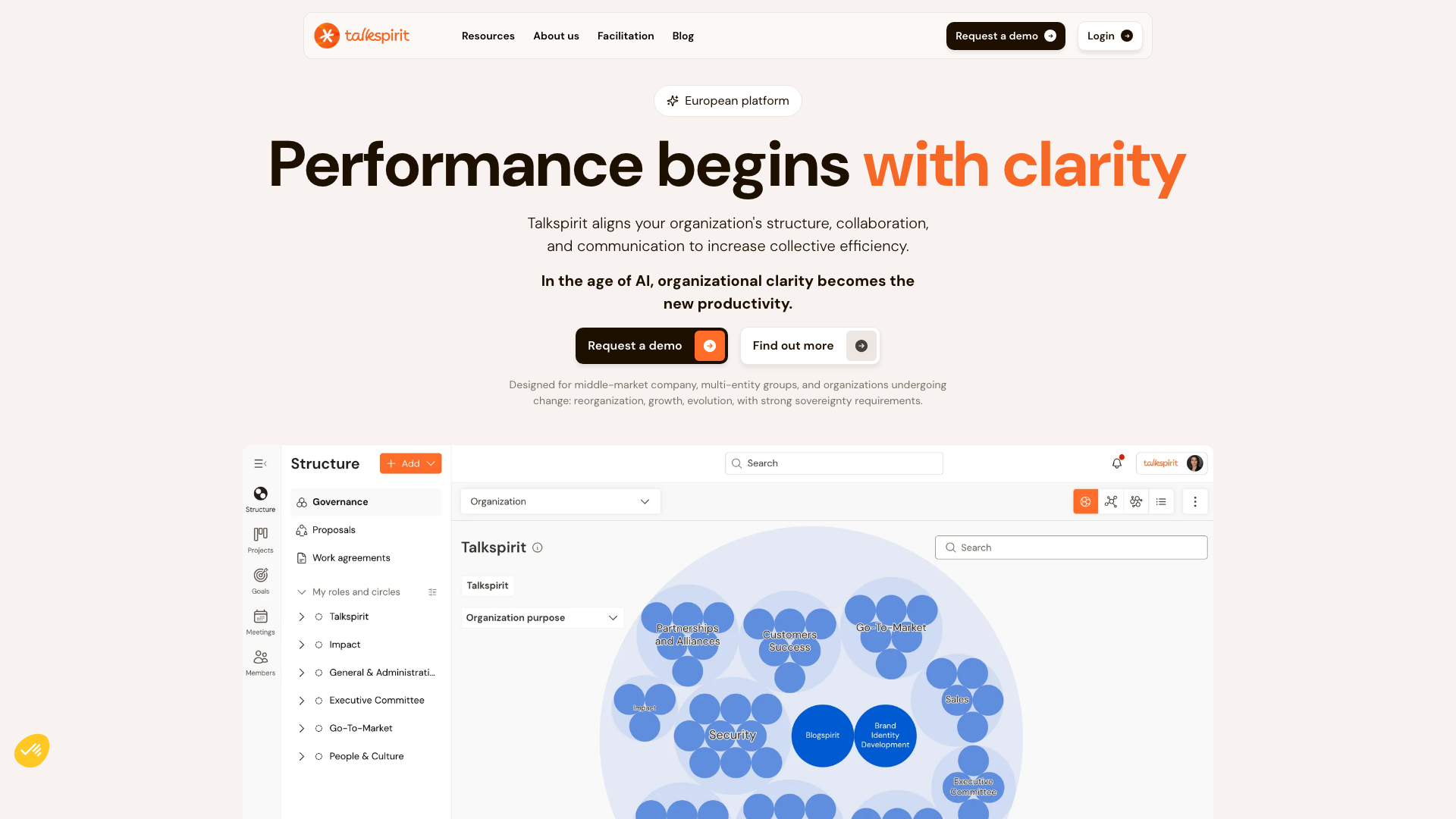
Holaspirit: a strong foundation, now in transition
Holaspirit has been a pioneer in the governance software space. Launched in France, it quickly became the go-to platform for Holacracy practitioners, offering role management, governance meetings, and OKR tracking. With support for 10 languages and a clean interface, it earned solid ratings (4.6/5 on Capterra) and built a loyal customer base.
Holaspirit and Talkspirit, two products from the same publisher, were first unified under one offer. Talkspirit then set 16 October 2026 as the closing date of the former Holaspirit platform. Customer organizations migrate to the new Talkspirit platform with their structure and history. They keep their subscription at the same price and for the same duration. Holaspirit's governance features become one module of a broader "Organisational Operating System." While this brought new capabilities in communication and collaboration, it also changed the product's focus and raised questions for teams that valued Holaspirit's dedicated governance approach.
Why teams look for Holaspirit alternatives
Based on user reviews from G2, Capterra, and community discussions, here are the most common reasons teams start exploring alternatives.
Governance changes feel cumbersome
Several users report that reorganizing roles and circles in Holaspirit can be tedious. There's no drag-and-drop for structural changes, and moving roles between circles requires multiple steps. For organizations that frequently adapt their structure, this friction adds up quickly.
Project management feels limited
Holaspirit's task and project tracking lacks features that many teams consider essential: no tags, no file attachments on tasks, limited commenting, no reminders or templates. Teams often end up maintaining a separate project management tool alongside Holaspirit, creating friction and context-switching.
Integrations only work one way
Microsoft 365 integration has been a long-standing request. Holaspirit connects to Slack, Microsoft Teams, Jira, Asana, Trello, and Basecamp, but tasks only travel one way, from Holaspirit to the project management tool. For teams relying on a broader tool ecosystem, this creates information silos.
API access requires premium plans
Developers who want to build custom integrations or automations find that API access is reserved for the Scale and Enterprise plans. For technically-oriented organizations, this limits extensibility.
Pricing has become opaque
Since Holaspirit was absorbed into Talkspirit, its pricing page redirects to Talkspirit's homepage, which shows no price and invites you to request a demo. For small organizations evaluating tools, this lack of transparency is a significant friction point.
No self-hosting option
Holaspirit is proprietary and cloud-only. Organizations with strict data sovereignty requirements or those who prefer to control their infrastructure have no option to self-host.
How Rolebase approaches things differently
Rolebase was built from the ground up as an open-source governance platform. Here's where it diverges from Holaspirit in ways that matter.
Open source and self-hostable
Rolebase's entire codebase is available under the AGPL-3.0 license on GitHub. This means:
- Full transparency: You can audit every line of code
- Self-hosting: Deploy on your own infrastructure if data sovereignty matters
- No vendor lock-in: Your data, your rules
- Community-driven: Contribute features, report bugs, or fork the project
For organizations that value independence and control, this is a fundamental difference. Holaspirit is proprietary with no option to inspect the code or run it on your own servers.
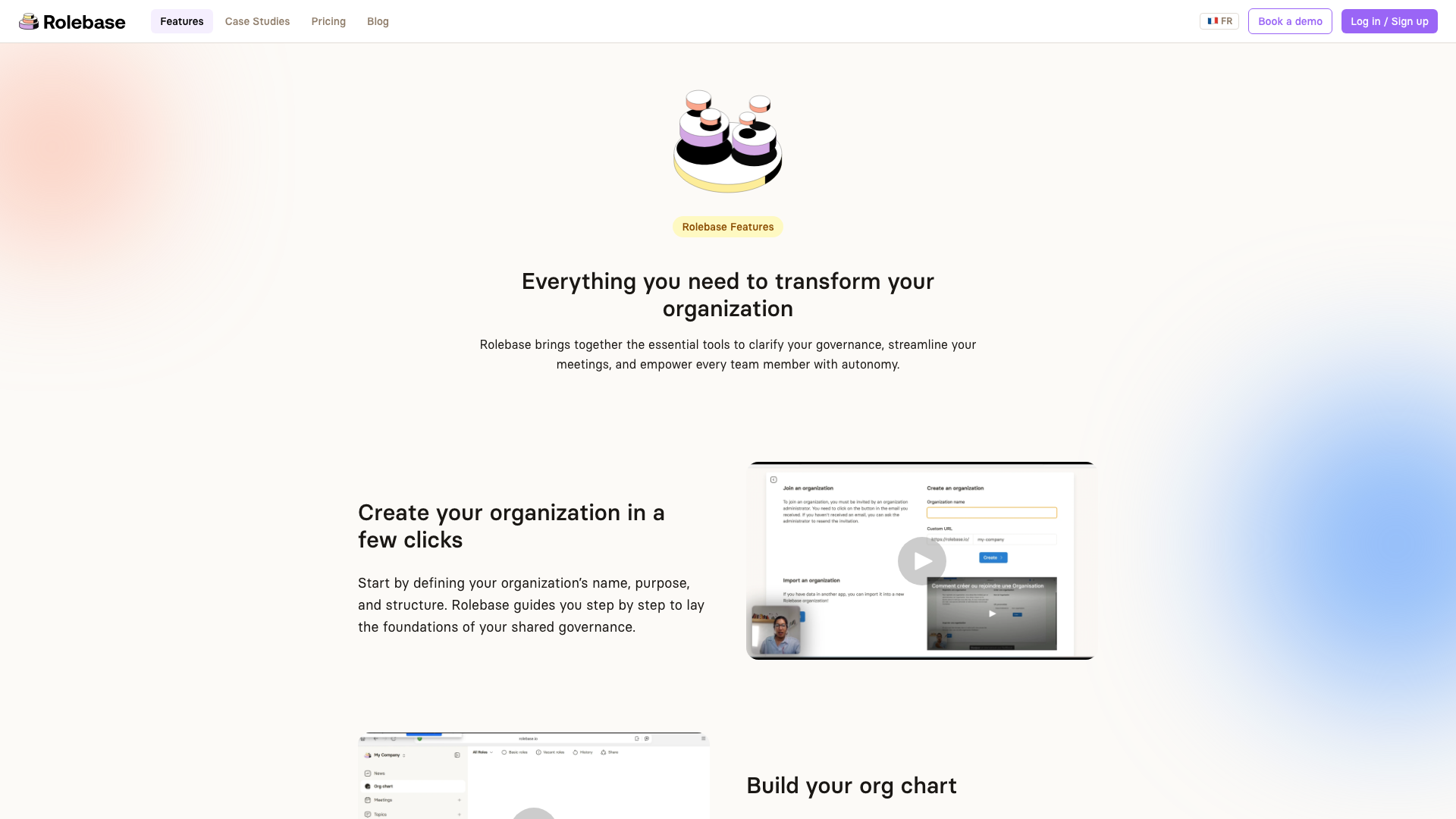
A unified, flexible org chart
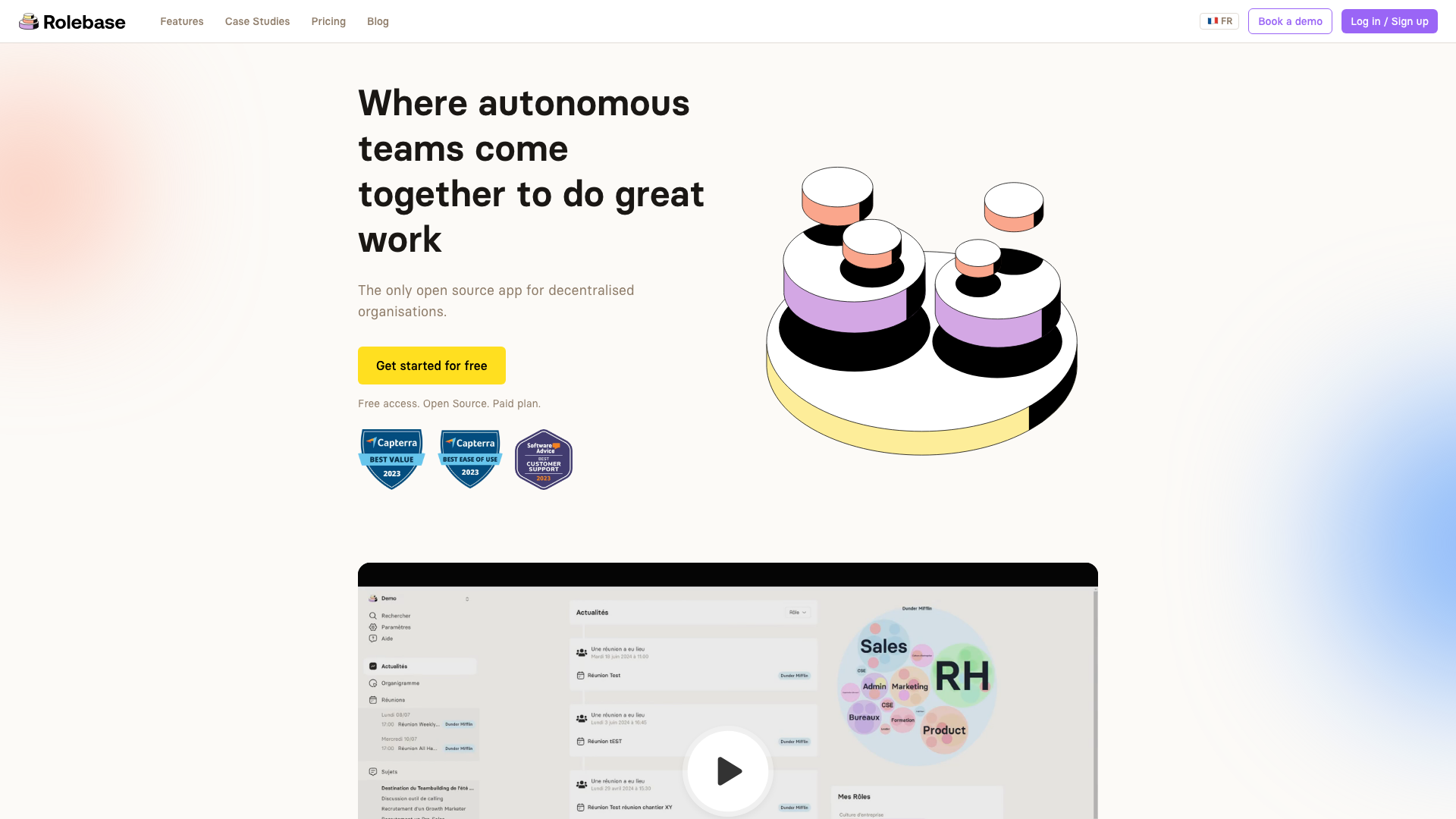
Rolebase uses a unified model where a circle is simply a role that contains sub-roles. This means any role can become a circle by adding sub-roles to it, without needing to create a separate entity. The result is a more intuitive and flexible structure that adapts naturally as your organization evolves.
Each role can include a Purpose, Domain, Accountabilities, Checklists, Indicators, and Notes. Changes can be made collaboratively in real-time, even during meetings, with drag-and-drop support.
Structured meetings that actually work
Rolebase's meeting system uses a step-based workflow: check-in rounds, discussions, checklist reviews, indicator tracking, and task management. Meetings follow customizable templates (tactical meeting, governance meeting, monthly retrospective).
Key features include:
- Recurring meetings with flexible scheduling
- Calendar sync with Google Calendar and Outlook
- AI-generated summaries after each meeting
- Video conferencing with Jitsi or a link to the tool you already use
- Private meetings for sensitive topics
Asynchronous decision-making with discussions
Not everything needs a meeting. Rolebase's discussions support structured asynchronous exchanges with a clear lifecycle (In preparation, In progress, Blocked, Done). Each discussion includes:
- Rich text messages with reactions
- Multiple choice and points-based polls
- Anonymous voting options
To make a decision, you put a proposal to a vote by consent, unanimity, or majority. Each member can then approve, consent, object, or abstain.
This reduces meeting overload while keeping decisions transparent and traceable.
Transparent, predictable pricing
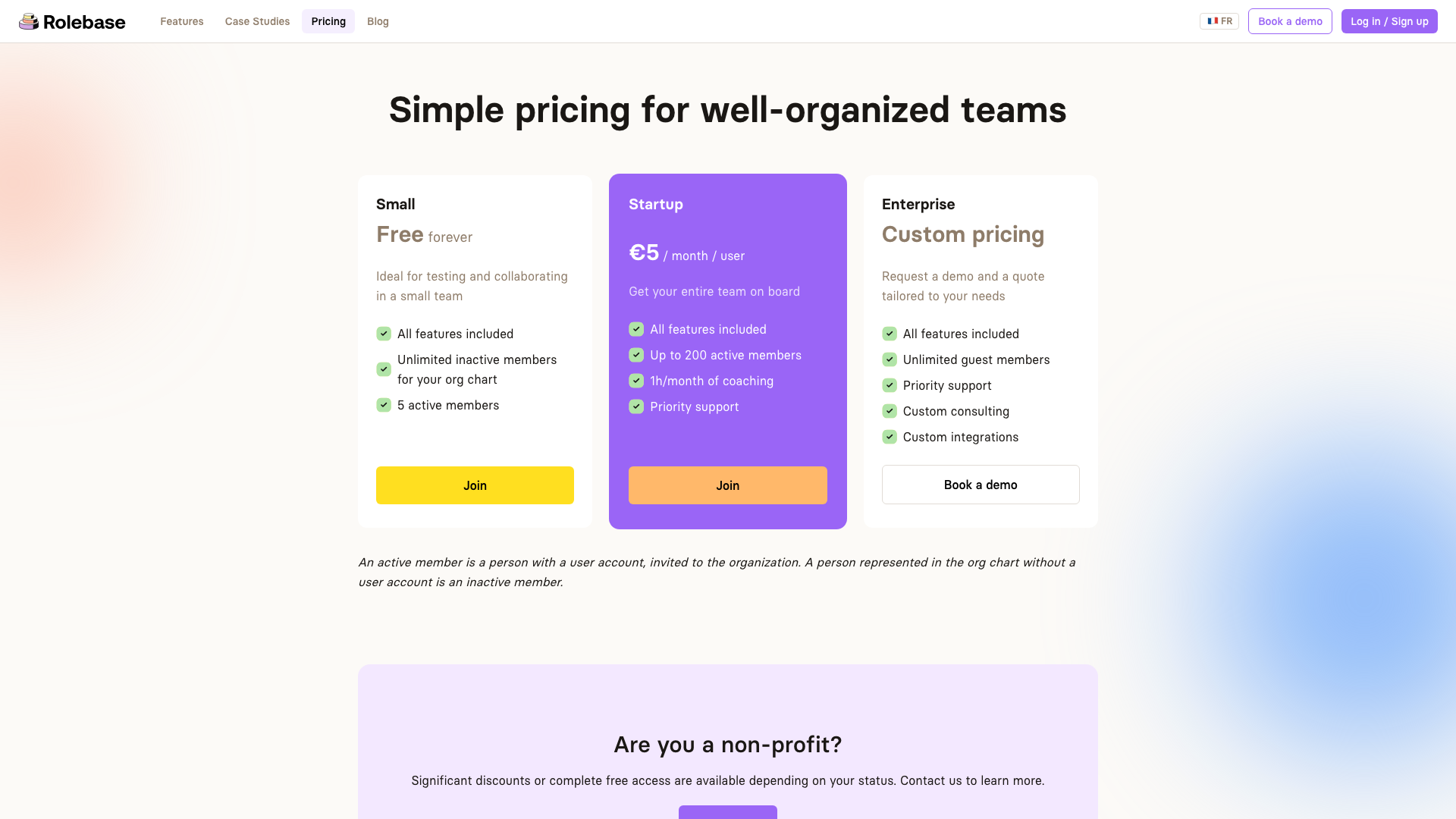
Rolebase's pricing is simple and publicly displayed (as of October 2026):
| Plan | Price | What you get |
|---|---|---|
| Free | Free forever | All features, up to 5 active members |
| Startup | 5 EUR/month/user | Unlimited active members, 1 hour of coaching per month, priority support |
| Enterprise | Custom | Unlimited guest members, custom integrations, custom consulting |
The free plan includes all features with no artificial limitations beyond the member count. Nonprofits can get significant discounts or free access. Archived members don't count toward your seat limit.
Direct import from Holaspirit
Switching shouldn't be painful. Rolebase offers a built-in Holaspirit import tool. You upload the Excel file of Holaspirit's admin export. The import then brings in your members, your circles and roles (purpose, domain, accountabilities, checklists, indicators), current role assignments, your policies as decisions, and your tasks. Past meetings stay in the export file, which you can keep as an archive.
Feature comparison
Here's a side-by-side comparison of key features (as of October 2026). Features and pricing change over time, so verify current offerings on each platform's website.
| Feature | Rolebase | Holaspirit (Talkspirit) |
|---|---|---|
| Governance frameworks | Holacracy, Sociocracy, custom | Holacracy, hierarchical, matrix, agile, custom |
| Org chart visualization | Interactive, drag-and-drop | Visual circles view |
| Structured meetings | Step-based with templates | Governance & tactical meetings |
| Async discussions | Discussions with polls & voting | Basic discussions |
| Task management | Kanban + list views, statuses | List, board and calendar views, subtasks |
| OKR tracking | Via indicators and checklists | Built-in OKR module |
| Calendar integration | Google Calendar, Outlook, iCal | Google Calendar |
| AI features | Role suggestions, meeting summaries | Spark assistant (search, summaries, writing) |
| API access | GraphQL API (all plans) | API (Scale and Enterprise plans) |
| Open source | Yes (AGPL-3.0 license) | No |
| Self-hosting | Yes | No |
| Free plan | 5 members, all features | 14-day trial |
| Apps | Web-based (responsive) | Desktop and Android apps |
| Languages | English, French | 10+ languages |
Pricing comparison
Let's look at what each platform costs for a typical team.
Holaspirit / Talkspirit (as of October 2026): Pricing is no longer publicly displayed. The plans are called Rise (up to 100 users), Scale (up to 300), and Enterprise (above 300). To get a price, ask the sales team for a quote. Holaspirit's historical pricing ranged from 3.90 to 4.90 EUR/user/month for standard plans, with flat-rate options at 79 and 149 EUR/month.
Rolebase: Starts free for up to 5 active members with all features included. The Startup plan at 5 EUR/user/month supports unlimited members. Only active members count toward billing.
For a team of 20 people:
- Rolebase Startup: 100 EUR/month
- Talkspirit, Rise plan: on quote
The key difference isn't just the sticker price. Rolebase's free tier lets you evaluate the full platform before committing, and the open-source option means you can self-host with zero licensing costs if you prefer.
Who should choose which?
Choose Holaspirit / Talkspirit if:
- You need a comprehensive communication suite alongside governance (chat, drive, intranet)
- Multi-language support across 10+ languages is essential for your team
- You're already deeply invested in the Talkspirit ecosystem
- You need OKR tracking as a core feature
Choose Rolebase if:
- Open source and code transparency matter to your organization
- You want or need self-hosting for data sovereignty
- You prefer clear, public pricing without sales calls
- You want a platform focused specifically on governance without feature bloat
- You're a small team that benefits from a generous free plan
- You need API access without paying for premium plans
- You value async decision-making with structured discussions and polls
- You're migrating from Holaspirit and want a smooth import
Making the switch
If you decide to move from Holaspirit to Rolebase, here's what the transition looks like:
- Create your Rolebase organization using the free plan to evaluate the platform
- Import from Holaspirit using the built-in import tool, which brings in your members, circles, roles, policies, and tasks
- Invite your team and let them explore the structure before your first meeting
- Set up meeting templates that match your current governance rhythm
- Cancel your Holaspirit or Talkspirit subscription once your team is comfortable
The import process preserves your organizational structure, so you won't need to rebuild from scratch. Most teams complete the transition within a week.
Conclusion
Holaspirit helped establish the governance software category and served many organizations well. But now that Talkspirit is merging it into its broader platform, teams focused specifically on governance and self-management may find that a more specialized, transparent tool fits their needs better.
Rolebase offers the governance depth that self-managed organizations need, with the openness and affordability that modern teams expect. Whether you're a 5-person startup exploring Holacracy or a large organization with strict data sovereignty requirements, Rolebase adapts to your context.


