
Governance Meeting: The Full Process, Step by Step
The Holacracy and sociocratic formats, what makes an objection valid, a realistic 90-minute run sheet, and the facilitation mistakes that keep recurring.
May 20, 2025
Updated on July 28, 2026
- A governance meeting changes the structure: roles, accountabilities, policies and elected positions. Current work belongs in a tactical meeting.
- Holacracy Constitution 5.0 sets three phases (check-in round, agenda building and processing, closing round) and six steps for processing a proposal.
- A concern only counts as an objection if it meets all four criteria in article 5.3.2. The facilitator tests the reasoning, never the substance.
- Ninety minutes a month handles three to five tensions, provided the meeting stops at the scheduled time.
A governance meeting changes the structure of a team. It settles who holds which role, with which accountabilities, under which policies, and who occupies the elected positions. Current work goes somewhere else, into a tactical meeting.
That boundary is the first thing generic articles on the subject drop. They hand you an agenda with "strategic items" followed by "operational items", which gives you back the usual team meeting with a new label on it. The actual process is written down: three phases in Holacracy, six steps to process a proposal, four criteria before a concern counts as an objection.
Three meetings, three different materials
| Governance meeting | Tactical meeting | Project meeting | |
|---|---|---|---|
| What it changes | Roles, accountabilities, policies | Nothing structural, it unblocks work | The content of a deliverable |
| What comes out | New or amended roles, policies, elected people | Accepted requests, next actions | Product calls, a scope |
| Who takes part | The circle members | The circle members | The people working on the deliverable |
| Common cadence | Monthly | Weekly | Whatever the project needs |
| Typical question | "Who decides this, and how far?" | "What is blocking me this week?" | "Which option do we go with?" |
Holacracy writes the boundary straight into the text. Article 5.2 of the Constitution lists the only valid outputs of a governance process: define, amend or remove the circle's roles, do the same with its policies, move roles and policies between a circle and a sub-circle, and hold elections for elected roles. The article closes the door with one line: "No other decisions are valid outputs from a Circle's Governance Process."
Most teams fold all three meetings into one two-hour weekly slot. In that slot the structure stays in the drawer, because operational urgency wins every trade-off. Separating the meetings protects the one piece of work nobody will ever ask for on their own.
The Holacracy process, article by article
HolacracyOne released version 5.0 of the Constitution in June 2021 under a Creative Commons licence. Article 5.4.3 fixes three phases, and the facilitator runs them in this order.
- The check-in round, where each participant shares their current state or another opening comment. The text keeps the floor with whoever is speaking, so nobody replies.
- Agenda building and processing, where the facilitator collects tensions and then works through them one at a time.
- The closing round, where each participant shares a closing reflection, again with no responses.
The agenda gets built inside the meeting
Article 5.4.4 is blunt about this: the facilitator builds the agenda during the meeting itself. Each participant adds as many items as they want, each one a short label, with no explanation and no discussion. More items can go up mid-meeting, between the processing of two existing ones.
The three-word label rule frustrates newcomers, who would much rather lay out their case. It exists to stop the negotiation from starting before the process does, in the corridor or during the check-in.
The facilitator picks the processing order, with one exception. On the request of any participant, an item calling for an election goes ahead of everything else.
The six steps of integrative decision-making
Article 5.4.5 governs how a proposal gets processed. Each step defines what is allowed and what the facilitator has to cut off.
| Step | What happens | What the facilitator stops |
|---|---|---|
| Present proposal | The proposer describes the tension and puts a proposal on the table. They may ask for help drafting it. | Other tensions, and any concern about the proposal |
| Clarifying questions | Anyone asks questions to understand the proposal or the tension. The proposer answers or declines. | Reactions, opinions, any exchange between participants |
| Reaction round | Each participant except the proposer reacts, one at a time. | Out-of-turn comments and reactions to other reactions |
| Option to clarify | The proposer responds to the reactions and amends the proposal if they want to. | Anyone speaking other than the proposer and the secretary |
| Objection round | Each person raises concerns in turn. With no objections, the proposal is adopted. | Discussion of any kind, and responses from anyone but the objector |
| Integration | The group looks for an amendment that clears the objection and still addresses the proposer's tension. | Amendments that hollow the proposal out |
The amend step carries a rule many facilitators forget. Article 5.4.5 (d) asks that amendments serve the proposer's own tension first. Tensions raised by other people belong in their own agenda items.
A proposal also has to clear an entry filter, described in article 5.3.1. The proposer must be able to name a tension affecting one of their roles, give a real past or present example of it, and explain how the proposal would have reduced that tension in that example. When the facilitator sees those three conditions missing, they have to discard the proposal. That single rule clears out most of the "wouldn't it be nice if" material.
What makes an objection valid
Article 5.3.2 sets four criteria, and the objector has to argue all four.
- The proposal would reduce the capacity of the circle to enact its purpose or accountabilities.
- It would limit the objector's capacity to enact the purpose or an accountability of a role they represent in the circle, even if they filled no other role in the organisation.
- The concern would appear with the proposal, rather than already existing without it.
- The proposal would necessarily cause that impact, or it might cause it without leaving the circle a chance to adapt before significant harm lands.
One extra case makes a concern count as an objection whatever the four criteria say: adopting the proposal would break a rule of the Constitution.
Article 5.3.3 keeps the facilitator on a short leash. They may test an objection by asking the objector how it meets the criteria, and they judge one thing only, whether the objector presented logical reasoning for each. The accuracy of the argument and the importance of the concern are out of reach. That limit keeps the facilitator from becoming the judge of substance, which would hand them exactly the power the process is trying to spread around.
Elections run on a separate process
The circle elects three roles: Facilitator, Secretary and Circle Rep. Article 5.3.5 defines the Integrative Election Process in six moves. The facilitator describes the role and sets a term, everyone nominates one eligible candidate on a ballot with no abstention and no multiple picks, the nominations are shared one by one with the reason behind each, a round lets people change their nomination, the facilitator proposes the candidate with the most nominations, and an objection round settles it.
Our article on election without candidates walks through that process and what separates it from an ordinary vote.
The meeting stops at the scheduled time
Article 5.4.2 states two rules that surprise people. The meeting ends as soon as it reaches the duration the secretary scheduled, and the secretary may extend it only if no circle member asks otherwise. On top of that, a member who misses part or all of the meeting counts as having had their chance to raise concerns, so the circle adopts proposals without them.
That second rule reads harsh. It removes the veto by absence, which quietly paralyses organisations that wait for everyone to be free.
A participant may call for a "Time Out" at any point, and the facilitator grants or denies it. The pause covers an administrative issue or a reading of the Constitution, and it stops there. Using it to work on a tension, a proposal or an objection stays off limits.
The sociocratic format, looser on the agenda
Sociocracy For All describes a meeting in three movements, with a suggested duration for each block.
The opening starts with a check-in round of around five minutes, where each person says what they are bringing into the room. An admin block of three minutes follows, covering attendance, the length of the session, consent to the previous minutes, announcements and the date of the next meeting.
The body of the meeting opens with consent to the agenda, two minutes in which the circle validates the items and states the outcome each one aims for. Items fall into three families: reports, which share information, explorations, which generate ideas on an open question, and decisions, which go through a consent round. A backlog update of five minutes captures follow-ups and topics for next time.
The closing is an evaluation round of five minutes, where each person speaks to three dimensions, the relationships in the group, the content produced and the process followed.
Three differences separate this format from the Holacracy one.
- The circle consents to its own agenda, where in Holacracy the facilitator builds it and picks the order.
- A sociocratic meeting happily mixes policy decisions and operational topics in one session, where Holacracy splits them across two meeting types.
- The sociocratic objection is broader. It is an argument that the proposal keeps the circle from reaching its aim, with no four-criteria grid to validate it.
Sociocracy For All also describes a proposal-forming process run in successive rounds, where the circle builds a shared picture of the issue before shaping the proposal itself. Our article on consent decision-making covers that mechanism, and the Holacracy and sociocracy comparison places the two models side by side.
A 90-minute run sheet
Here is roughly how a monthly session for a circle of eight breaks down.
| Slot | Step | What happens there |
|---|---|---|
| 0:00 - 0:08 | Check-in round | One minute per person. The facilitator cuts off any exchange that starts. |
| 0:08 - 0:14 | Agenda building | Six to ten three-word labels, no explanations. |
| 0:14 - 0:35 | Two simple tensions | Five to ten minutes each, usually adopted on the first objection round. |
| 0:35 - 1:10 | One contested tension | Twenty to thirty minutes, with one or two integration loops. |
| 1:10 - 1:22 | A last tension | Whatever is left waits for the next session. |
| 1:22 - 1:30 | Closing round | One minute per person. |
Three to five tensions per session is what a circle actually gets through. Teams that block two and a half hours "to be safe" fill two and a half hours and come out drained. Ninety minutes a month, with the constitutional rule that cuts the meeting off on time, produces more. Whatever goes untreated comes back next month, which costs thirty days at worst. A role that has been wrong for a month has already been wrong for six.
Three tensions, to see what this looks like
Who approves quotes above ten thousand
The tension comes from the Sales role, which watched two quotes sit for a week. The proposal adds an accountability, "approves quotes above ten thousand", to the Finance role. The reaction round points out that the threshold is arbitrary. In the objection round, the person filling Finance objects, because they travel two weeks a month and every quote would wait for their return. The objection clears all four criteria. Integration adds "or the person they designate as backup", and the proposal passes.
Client requests arrive through four channels
The tension comes from the Support role, drowning in direct messages. The proposal creates a Front Desk role with the support@ inbox as its domain. One reaction judges the load too heavy for a single person. The proposer amends it to a weekly rotation on their own initiative, since that amendment serves their own tension. No objection surfaces on the next round, and the proposal passes.
A preference dressed up as an objection
The facilitator tests it. How does this role name reduce the circle's capacity to enact its purpose? The objector has nothing on that point, only an aesthetic preference. The first criterion fails, the objection drops, the proposal is adopted. This test is precisely what keeps the meeting from turning into a contest of opinions.
The facilitation mistakes that keep recurring
- Letting discussion settle in during clarifying questions. The text requires the facilitator to stop every reaction and opinion at that step. One question disguised as an objection is enough to derail everything after it.
- Preparing the agenda the night before. Article 5.4.4 requires building it in the room. An agenda circulated a week ahead is already stale, and it invites everyone to sharpen arguments instead of listening.
- Letting the proposer amend to please the room. A proposer who absorbs every remark from the reaction round ends up with a proposal nobody defends. The amendment has to serve their tension.
- Accepting as an objection what is still a preference. The four criteria exist for that, and applying them out loud teaches the group to phrase concerns properly.
- Judging the substance of an objection. The facilitator checks that reasoning was presented, and nothing more. The moment they weigh relevance, they become the decision-maker.
- Stretching the session by twenty minutes to finish. The Constitution keeps that door shut unless everyone agrees. Time discipline is what makes the meeting bearable over years.
- Facilitating and proposing at the same time. A facilitator who wants to carry a tension hands facilitation over for that item. The Constitution even provides surrogates for the Facilitator and the Secretary.
- Postponing because two people are away. Absent members count as having had their chance to object. Waiting for full attendance amounts to never doing governance at all.
Running these meetings in Rolebase
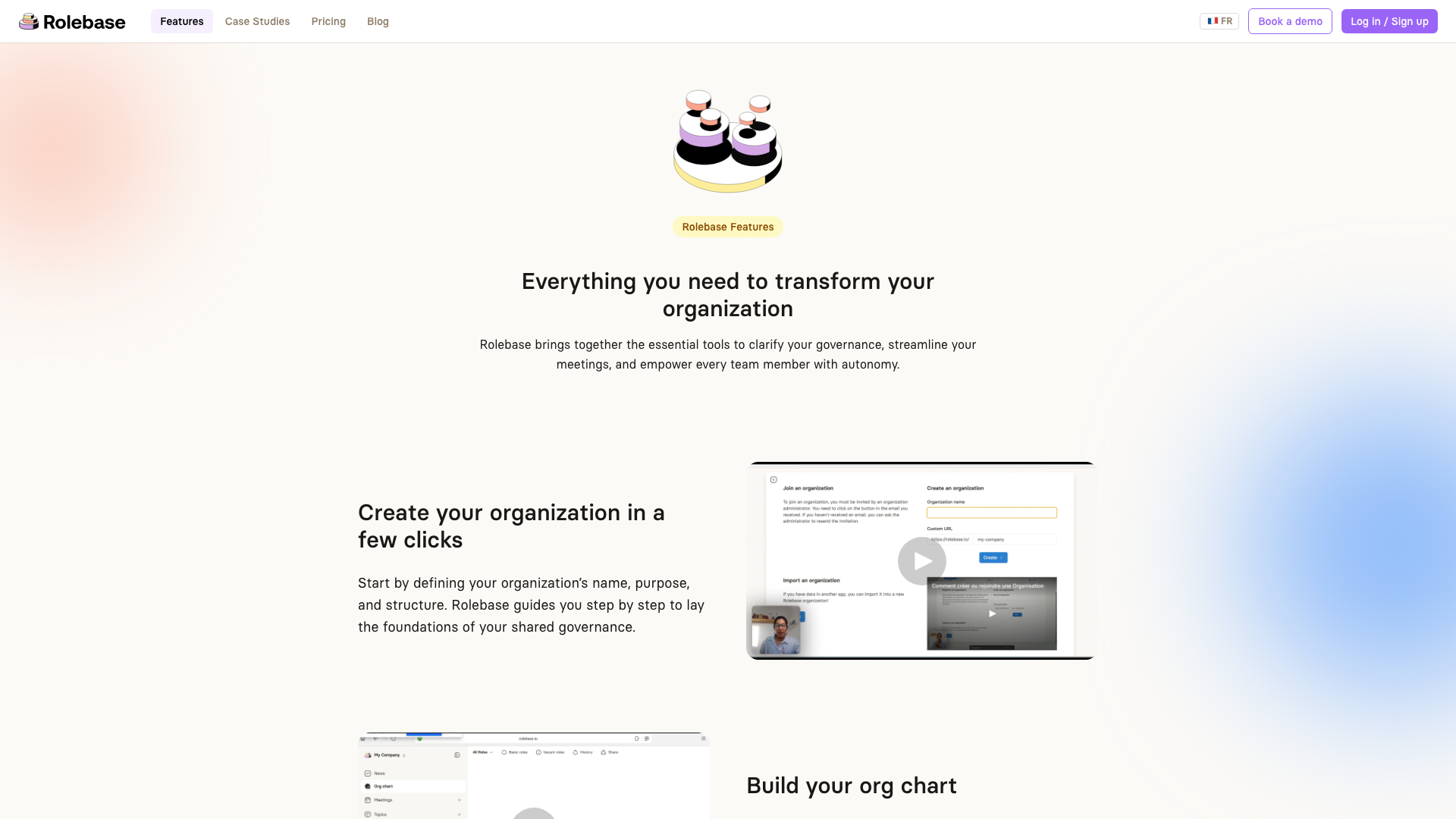
In Rolebase a meeting belongs to a role and consists of ordered steps. Five step types exist: talking round, discussions, checklist, indicators and tasks. A meeting template stores a reusable sequence, so you can keep a full tactical template and a lean governance template side by side, the second one down to a talking round and discussions.
The integrative process itself stays in the facilitator's hands. Rolebase handles the logistics: the agenda drawn from the role's discussions, live notes on each step, and the record of what was decided.
- Meetings repeat on a recurrence rule, sync with Google Calendar or Office 365, and export as an iCal feed.
- A proposal combines a decision put to a vote with the org chart changes that go with it. Those changes stay pending and apply on approval, which lets you prepare the new structure before asking anyone to validate it.
- Decisions recorded in a role form the log a new member goes back to in order to understand how the organisation works today.
- The organisation's governance mode sets who can edit the org chart. In Strict mode every role change goes through a proposal, which brings the behaviour close to the Holacracy rule.
- When the meeting ends, Rolebase produces a report with the date, the participants, the notes from each step, the tasks created and the decisions taken, with an automatic summary if you turn it on.
The guide on running your first meeting covers the full path, and the one on raising and processing a tension shows how a discussion turns into a proposal, a task or a decision.
Frequently asked questions
What is the difference between a governance meeting and a tactical meeting?
A governance meeting changes the structure. It creates, amends or removes roles and policies, and it holds elections. A tactical meeting moves current work forward by processing requests between roles, leaving the structure alone. In Holacracy, article 5.2 of the Constitution lists the only valid outputs of a governance process, while article 3.2 describes the tactical meeting process, which includes a checklist review, a metrics review and progress updates.
How long should a governance meeting last?
Ninety minutes suits a circle of eight people processing three to five tensions. The Holacracy Constitution states that the meeting ends as soon as it reaches the duration scheduled by the secretary, and that the secretary may extend it only if no circle member asks otherwise. Remaining items roll into the next session.
How often should you hold a governance meeting?
Monthly works for most teams. The Constitution asks for regular meetings and leaves the cadence to the secretary, without prescribing a frequency. A team that has just started benefits from meeting every two weeks until the roles settle, then moving to monthly.
Who takes part in a governance meeting?
Every member of the circle concerned. The acting Facilitator and Secretary also take part even when they are not circle members, and they become temporary circle members for the duration of the meeting. A Circle Rep may invite one partner at a time into the meeting of the circle immediately above, to help process a specific tension affecting the circle they represent.
What counts as a valid objection?
Article 5.3.2 of the Holacracy Constitution requires four conditions together. The proposal would reduce the circle's capacity to enact its purpose or accountabilities, it would limit the objector's capacity to enact a role they represent, the concern would appear with the proposal rather than already exist, and the impact would be certain or would land before the circle could adapt. A concern also counts as an objection whenever adopting the proposal would break the Constitution.
How do you build the agenda for a governance meeting?
The agenda gets built in the room, right after the check-in round. Each participant announces as many items as they want, each one a short label, with no explanation and no discussion. More items can go up between the processing of two existing ones. The facilitator picks the order, with one exception: on the request of any participant, an item calling for an election goes first.
Can you hold governance meetings without adopting Holacracy?
Yes. The sociocratic format described by Sociocracy For All runs on a check-in round, an admin block, consent to the agenda, the substantive items and an evaluation round, with no constitution to ratify. A team can also borrow the two mechanisms that carry most of the result: building the agenda in the room, and requiring an objection to name the capacity being lost.
What to take away
The governance meeting rests on two rules, and the rest follows. The first puts structural changes in this session and keeps everything else out, which shields that work from operational urgency. The second requires an objection to name the capacity being lost, which turns a debate of opinions into a feasibility check.
A team that applies those two rules for ninety minutes a month watches its structure keep pace with its activity, instead of trailing a year behind. The rest of the integrative process is implementation detail, and a circle that picks it up along the way does perfectly well.


