
Consent Decision Making, Step by Step
Where the method comes from, how a consent round runs, what makes an objection valid, and the decisions it handles badly.
May 18, 2025
Updated on July 28, 2026
- Consent asks whether a reasoned objection remains. Consensus asks whether everyone agrees.
- Gerard Endenburg formalised the principle at Endenburg Elektrotechniek in the 1970s, building on the work of Quaker educator Kees Boeke.
- Holacracy goes further and sets four cumulative criteria a concern must meet to count as an objection.
- The process belongs to governance, meaning roles and policies. Day-to-day calls are made alone, inside a role.
A six-person team spends forty minutes on a budget question. Everyone gives an opinion, nobody decides, and the next meeting picks the topic up again from the start. The blockage comes from the question on the table. "Does everyone agree?" opens a discussion with no end. "Does anyone see a serious reason not to try this?" closes it in ten minutes.
That gap between agreement and absence of objection is the whole point of consent decision making. This article walks through the process as it is written in sociocracy and in Holacracy, shows objections that clear the bar next to objections that do not, and says plainly what the method handles badly.
Consent and consensus ask different questions
Consensus looks for buy-in from everyone. As long as one person prefers another solution, the conversation continues. Consent looks for the absence of a reasoned objection. A proposal passes as soon as nobody can show why it would harm the group's work.
"With consensus, I have to convince you that I am right. With consent, you ask yourself whether you can live with the decision."
Annewiek Reijmer, Sociocratisch Centrum
The shift is a shift in the burden of proof. Under consensus, the person proposing has to persuade. Under consent, the person blocking has to argue. An objection also carries more weight than a vote against, because it obliges the group to rework the proposal together with its author.
| Method | Question asked | What blocks | Typical cost |
|---|---|---|---|
| Unilateral call | None | Nothing | Fast decisions, frequent blind spots |
| Majority vote | Are you in favour? | A minority of votes | Up to 49% of the group is left out |
| Consensus | Do you agree? | A preference | Long discussions, watered-down proposals |
| Consent | Do you see an objection? | A reasoned argument | Group training and facilitator discipline |
Circle Forward, the collaborative governance practice founded by Tracy Kunkler, puts the substance of it well.
"Consent is a principle, not a process. Like informed consent when practiced in the physician-patient relationship, it's grounded in respect for autonomy, transparency, and the right to self-determination."
Where the method comes from
Auguste Comte coined the word "sociocracy" in 1851, in his Système de politique positive. The modern meaning arrives with Kees Boeke, a Quaker educator who opened the Werkplaats Kindergemeenschap school in Bilthoven, in the Netherlands, in 1926 with Betty Cadbury. Boeke published Sociocracy: Democracy as It Might Be in 1945, describing a governance built on the agreement of all rather than on voting. Quaker meetings had been reaching decisions without a vote since the 17th century.
Gerard Endenburg, an engineer and a former pupil of Boeke, took over the family firm Endenburg Elektrotechniek in 1968. In 1970 he brought the headcount down from 160 to 100 to give himself a laboratory he could handle, then spent a decade testing, measuring and starting over. Out of that came the Sociocratic Circle Organisation Method, built on four principles: consent, the circle, the double link between a circle and the one containing it, and election by consent with open nomination. He founded the Sociocratisch Centrum in 1978 to take the method beyond his own company.
Holacracy picks up consent and tightens it. Brian Robertson developed the system at Ternary Software in Pennsylvania and founded HolacracyOne with Tom Thomison in 2007. The first version of the constitution appeared in May 2009, version 5.0 in June 2021. Where sociocracy leaves the group to judge what counts as an objection, Holacracy writes four cumulative criteria and gives the Facilitator the power to discard a concern that fails them.
James Priest and Bernhard Bockelbrink launched Sociocracy 3.0 in March 2015, joined shortly after by Liliana David. They break the whole thing into independent patterns and made famous the question that tests any proposal: is this good enough for now, and safe enough to try?
For a side-by-side reading of the two frameworks, see Holacracy vs sociocracy.
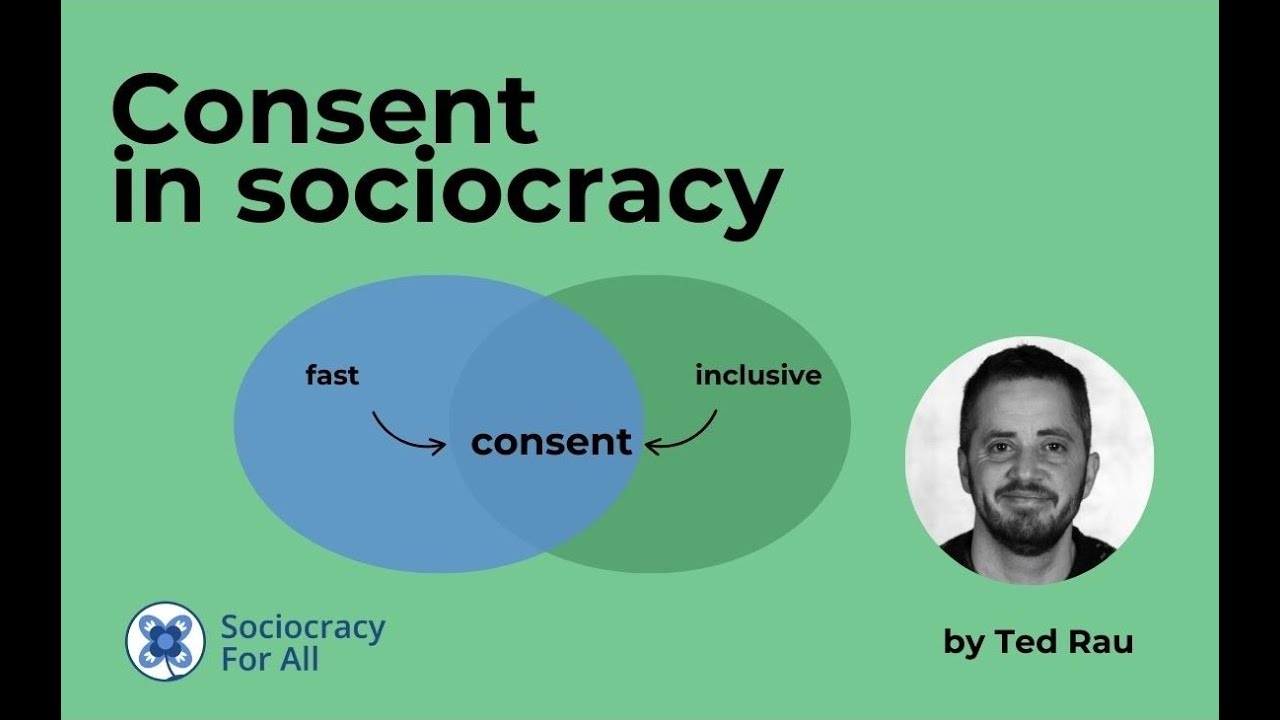
How a consent round runs
Take a team of six. The Finance role notices that every small purchase waits for approval in a meeting, which costs one to two weeks each time. The person holding the Purchasing role brings this proposal: each role holder may commit up to €500 from their role's budget without prior approval, for six months, with a review in January.
- The author opens by describing the tension, then reads the written proposal. In Holacracy they must be able to cite a real past or present situation that illustrates the tension, and explain how the proposal would have reduced it. A proposal that fails that test is discarded on the spot.
- The clarifying round lets everyone ask questions of understanding, one at a time. The facilitator stops every reaction, every opinion and every attempt at debate. "Does the cap apply per purchase or per month?" belongs here. "I think this is risky" waits for the next round.
- The reaction round gives each person one short turn to say what the proposal does to them, with nobody replying to anybody. It surfaces the information the author did not have.
- The author then takes the floor back, responds to the reactions and amends the proposal if they want to, keeping the focus on their own tension rather than on tensions raised by others. Nobody else speaks.
- The objection round starts with a yes or a no from each participant. The facilitator captures objections without opening discussion. When the round comes back empty, the proposal is adopted.
- Integration handles objections one at a time. The group looks for an amendment that clears the objection while still resolving the author's tension. Each objection cleared sends everyone back to the objection round with the amended proposal.
- Recording writes the adopted decision down with its date, its scope, its review deadline and the objections integrated along the way.
The clarifying and reaction rounds look like bureaucratic ceremony. They do most of the work, because they stop the most confident speaker in the room from filling the space before anyone else has spoken. The French tradition popularised by the Université du Nous adds a closing celebration to the same sequence, which sounds decorative and turns out to matter for groups learning the format.
Say "do you see a reason this proposal would harm our work?" rather than "do you agree?". The first calls for an argument, the second calls for a preference.
What counts as a valid objection
Sociocracy 3.0 defines an objection as an argument, about a proposal or an existing agreement, that reveals consequences or risks worth avoiding, or shows a worthwhile way to improve. Three questions test it: how would carrying on this way fail to respond to the need, how would it lead to undesirable consequences, how would it waste a worthwhile improvement. A worry that cannot yet be backed by reasoning stays a concern. It gets recorded and it does not block.
Holacracy is stricter. Its constitution 5.0, at article 5.3.2, treats a concern as an objection only if the objector argues all four of the following.
- The proposal would reduce the circle's capacity to enact its purpose or accountabilities.
- It would limit the objector's capacity to enact the purpose or an accountability of a role they represent in the circle.
- The concern does not already exist in the absence of the proposal, so a new tension is created specifically by adopting it.
- The proposal would necessarily cause that impact, or might cause it without giving the circle an adequate opportunity to adapt before significant harm results.
One case always counts as an objection whatever the criteria say: adopting the proposal would break a rule of the constitution itself.
Article 5.3.3 adds a safeguard many teams miss. When testing an objection, the Facilitator judges only whether the objector presented reasoning for each criterion. They may judge neither the accuracy of the argument nor the importance of the problem raised. The Facilitator's power covers form and never substance.
Applied to the €500 cap, this produces four very different answers.
| Said in the objection round | Status | Why |
|---|---|---|
| "Six roles at €500 means €3,000 committed in a month, while our cash drops to €1,800 in February. I can no longer hold my accountability of paying suppliers within 30 days." | Objection | Numbers, tied to an accountability, and the risk comes from the proposal |
| "€500 feels like a lot to me." | Preference | No consequence named, no reasoning |
| "We don't track our spending anyway." | Concern | The problem exists already, with or without the proposal |
| "At thirty people this will fall apart." | Concern | The proposal runs six months and has a review, so the group can adapt |
The dividing line sits there. An objection names a harm, ties it to work the group committed to, and shows the proposal causes it. Everything else is useful information to record and to look at again at the review.
When an objection will not clear
The first move is to change the content of the proposal. In the example, Finance's objection clears with the cap lowered to €300, a monthly ceiling of €1,500 across all roles, and January and February excluded. The author keeps their tension resolved, the objector gets their supplier payments back.
Sociocracy For All describes two further moves that unlock a good share of deadlocks.
Shortening the term turns a decision into an experiment. Three months instead of six makes the bet acceptable, because the review lands before the feared risk has time to cost anything.
Measuring the concern means adopting the proposal as it stands and putting a metric in place that will show whether the worry comes true. Here, the total committed each month across all roles. The review then settles the question on numbers rather than on impressions.
Some cases still refuse to clear. Sociocracy sends the topic up to the circle containing the stuck one, through the double link, and that circle decides on its behalf. Holacracy takes a different route. The objector has to look in good faith for an amendment that clears their objection while still resolving the author's tension, and the Facilitator drops an objection they judge abandoned. The symmetry holds on the other side too: when the objector suggests an amendment, the author must explain precisely why it would fail on at least one of their own examples, otherwise the Facilitator drops the proposal.
Either way, a proposal that fails leaves the previous rule standing. The group always keeps a frame to work from.
What consent decision making does badly
The process costs meeting time, and that cost climbs with the number of participants. Six rounds with six people fit in twenty minutes. With twenty people the same proposal eats half a day. This is exactly why sociocracy works in small circles joined by double links rather than in assemblies. Buurtzorg, the Dutch home care network founded in 2006 by Jos de Blok, runs its roughly 14,000 nurses in teams of no more than twelve, with no managers.
The most common mistake is running every decision through consent. Holacracy guards against it explicitly. Its article 4 gives every role holder the authority to take any action or decision that enacts their role's purpose and accountabilities. Tactical meetings handle requests between roles, with no objection round anywhere. Consent belongs to governance, meaning whatever creates, amends or removes roles and policies. A team that puts the choice of a supplier or a delivery date through a consent round manufactures the very slowness it blamed on consensus.
Urgency sits outside the frame as well. The constitution provides for individual initiative: acting beyond the authority of your role, or against a rule, when waiting would cost a lot, on condition that you explain the action afterwards to whoever it touched and help repair whatever it created.
Other decisions belong to the legal employer. Hiring, pay, discipline and dismissal carry liability that no circle can absorb in most jurisdictions. A circle can prepare those topics, inform them and recommend a direction, and the final call sits elsewhere.
A group that has not worked on the objection criteria drifts back within a few sessions into a preference round in disguise, where "objection" is how people say "I don't like it". The facilitator holds that line alone. A consent round where nobody tests objections is consensus with more flattering vocabulary.
How to start
- Pick the scope. Start with the decisions about how you work, meaning who decides what, which rules apply, how the work is shared. Leave operational calls to the people holding the roles.
- Name a facilitator and give them an explicit mandate to interrupt. Without that mandate, the rounds collapse into open discussion by the second meeting.
- Write proposals in advance, in four blocks: the tension observed with a dated example, the proposal, the trial period, the review date.
- Put the objection criteria on the wall or in the document. The group reads them out loud for the first few sessions, until the reflex sticks.
- Begin with low-stakes topics. The first rounds exist to learn the format, and the question that has divided the team for two years can wait.
- Record every decision with its review date. A decision without a review hardens into a fixed rule, and the organisation ends up with the problem it set out to avoid.
- Keep trial periods short at the start. Three months makes yes easy, and a decision you can undo in January gets made in October.
For the container around these rounds, the governance meeting article describes the full format, and the guide on raising a tension shows how a daily annoyance becomes a proposal. If the vocabulary of roles and purpose is still new, start with sociocracy in practice and defining roles.
Running consent rounds in Rolebase
Rolebase carries the process inside the tool rather than in a shared document. A proposal is created from a discussion, with a decision mode you choose: consent, unanimity, simple majority or absolute majority. In consent mode, voters get two buttons, "I consent" and "I object".
You choose who votes, either the participants of the discussion or the participants of the role. Early resolution settles the proposal as soon as the outcome is certain, which means a single objection stops it immediately and sends everyone into integration. An optional deadline closes the round even when some voters stay silent, which makes consent workable asynchronously. Holacracy has allowed the same written flow since version 5.0, with a policy-defined time limit after which silence counts as no objection.
A proposal can carry the org chart changes it decides: creating, moving or archiving a role, editing its purpose and accountabilities, adding or removing members. Those changes stay pending and apply to the real org chart once the proposal is approved. The decision is then recorded in the role concerned, visible to everyone or restricted to the participants of that role.
The Strict governance mode makes this path mandatory for any structural change, while the Free and Agile modes let roles be edited directly. Meetings are built from steps you order yourself, including a talking round, discussions, tasks, checklists and metrics, and they replay identically through templates and recurring meetings.
The screen-by-screen detail lives in the documentation on proposals, decisions and governance modes.
Frequently asked questions
What is the difference between consent and consensus?
Consensus asks whether everyone agrees with the proposal, and a simple contrary preference is enough to block it. Consent asks whether a reasoned objection remains, meaning a demonstrated reason why the proposal would harm the group's work. Annewiek Reijmer, of the Sociocratisch Centrum, sums it up this way: with consensus, I have to convince you that I am right, with consent, you ask yourself whether you can live with the decision.
What makes an objection valid?
In Sociocracy 3.0, an objection is an argument that reveals consequences or risks worth avoiding, or shows a worthwhile way to improve. In Holacracy, constitution 5.0 requires four cumulative conditions: the proposal would reduce the circle's capacity to enact its purpose or accountabilities, it would limit the objector in a role they represent, the concern does not already exist without the proposal, and the proposal would cause that impact without leaving room to adapt. A worry that fails those conditions stays a concern, recorded for the review.
What do you do when an objection will not clear?
The group has four moves. It changes the content of the proposal so it still resolves the author's tension while removing the risk. It shortens the trial period, three months instead of a year. It adopts the proposal with a metric in place that measures the worry, so the review settles the question on numbers. When none of that works, sociocracy sends the topic up to the parent circle through the double link. The previous rule stays in force until a new decision is adopted.
Is consent decision making slow?
It is fast on governance decisions in a small group, and slow everywhere else. Six rounds with six people fit in twenty minutes. The same process with twenty people eats half a day, which is why sociocracy works in small linked circles rather than in assemblies. A team that runs its daily decisions through a consent round gets back exactly the slowness it blamed on consensus.
Should every decision go through consent?
No, and the frameworks that use it say so plainly. Holacracy reserves consent for governance, meaning whatever creates, amends or removes roles and policies. Its article 4 gives each role holder the authority to decide alone on anything that enacts their role's purpose and accountabilities. For emergencies, the constitution provides individual initiative, which allows acting immediately on condition of explaining and repairing afterwards.
Who invented consent decision making?
Auguste Comte coined the word sociocracy in 1851. Quaker educator Kees Boeke gave it its modern meaning in his 1945 text Sociocracy: Democracy as It Might Be, drawing on the Quaker practice of deciding without a vote. Gerard Endenburg, his former pupil, formalised the consent principle in the 1970s at Endenburg Elektrotechniek and founded the Sociocratisch Centrum in 1978. Brian Robertson picked it up and tightened it in Holacracy from 2007.
What is consent decision making called in Holacracy?
Holacracy calls its variant the Integrative Decision-Making Process, defined at article 5.4.5 of constitution 5.0. It runs six steps: present proposal, clarifying questions, reaction round, option to clarify, objection round, integration. Sociocracy uses the plainer name consent decision making, and the French tradition calls it gestion par consentement.
What to take away
Consent decision making earns its place through the question it asks. It swaps "who is right?" for "what stops us from trying?", and that swap alone removes half the arguments in a meeting. The rule then has to be held. A group that accepts any reservation as an objection has simply renamed its consensus.
Two conditions make the difference over time. The facilitator tests objections on their form and leaves their merits to the group. The scope stays narrow, with consent covering roles and policies while each person decides alone inside their own.
Rolebase gives that process somewhere to live: proposals voted by consent, org chart changes prepared then applied on approval, and every decision kept in the role that carries it. See the features, or create your organization free for up to five active members.


