
Tactical Meeting: The Seven-Step Process Explained
The seven steps of article 3.2 of the Holacracy Constitution, a realistic run sheet, real triage examples, and what the facilitator cuts off.
May 19, 2025
Updated on July 28, 2026
- A tactical meeting moves current work forward. Roles, accountabilities and policies change in a governance meeting instead.
- Article 3.2 of the Holacracy Constitution sets seven steps, from the check-in round to the closing round, with the agenda built inside the meeting.
- Triage produces requests aimed at a person or a role, and article 2.2 defines three kinds, each with its own duty to respond.
- The Constitution gives time management to the Facilitator and publishing to the Secretary, with no timekeeper role anywhere in the text.
A tactical meeting moves this week's work forward. You go there to get information out of someone, to get an action taken, or to get permission to touch a domain they control. Creating a role, adding an accountability or setting a policy happens somewhere else, in a governance meeting.
Most articles on the subject hand you a corporate agenda with information items, then discussion items, then decision items. That plan comes from no framework at all, and it gives you back the usual team meeting under a fresh name. The tactical meeting process is written down. Article 3.2 of the Holacracy Constitution 5.0 sets seven named steps in a fixed order, and the nickname "triage meeting" comes from the sixth one, "Triage Items".
Who calls it, and who attends
Article 3 lets any Partner convene a tactical meeting to help others engage each other in their responsibilities and duties. The Circle's Secretary carries a separate accountability, scheduling the Circle's regular tactical meetings.
For those regular meetings, article 3.1 invites all of the Circle's Roles unless a Policy says otherwise. When someone else convenes the meeting, that person names the Roles invited, and the Role Leads for those Roles attend to represent them.
Article 3.2 splits two responsibilities. The Circle's Facilitator runs the regular tactical meetings, and the Secretary captures and publishes the outputs. Outside that regular frame, whoever convenes the meeting facilitates it and captures its outputs, or hands both tasks to a volunteer or an appropriate Role.
Plenty of articles add a timekeeper to that list. The role comes from ordinary facilitation practice, and the Constitution has no such thing: it gives time management to the Facilitator, inside the triage step. The four roles the text does define are Circle Lead, Facilitator, Secretary and Circle Rep.
The seven steps of article 3.2
| Step | What the text requires |
|---|---|
| Check-in Round | Each participant in turn shares their current state or another opening comment. The text disallows responses. |
| Checklist Review | Each participant verifies completion of the recurring actions they report on regularly for their Roles. |
| Metrics Review | Each participant shares the metrics they report on regularly for their Roles. |
| Progress Updates | Each participant highlights progress on a project or initiative they report on regularly. The text restricts this to progress made since a prior report. |
| Build Agenda | Each participant adds as many items as they want, each a short label, with no explanation and no discussion. More items may go up later, between the processing of two existing ones. |
| Triage Items | The agenda item owner makes requests of another participant, either as a Partner or to a Role that participant represents. The Facilitator allocates time and cuts an item that overruns. |
| Closing Round | Each participant in turn shares a closing reflection. The text disallows responses here too. |
A Policy of the Circle may replace this process or amend it for tactical meetings called by any of the Circle's Roles. That is the only exit the text provides, and it goes through a governance decision.
Four of the seven steps are readouts. Half the session goes to reporting before a single topic gets processed. Those readouts come from the duty of transparency in article 2.1, which already obliges everyone to share their checklist items, their metrics and their progress when another Role Lead asks. The tactical meeting batches them into one slot instead of letting them arrive one interruption at a time.
What a request actually is
Article 2.2 defines three kinds of request, and each one carries a specific duty to respond. That duty is what separates triage from a wish expressed out loud in a team meeting.
- A request to clarify asks for the next steps on a project or on an accountability. The person asked determines and communicates a next-action, or says what they are waiting for before they can take one.
- A request for a project or a next-action asks someone to take work on. They accept and track it if they believe it makes sense for one of their Roles, at least absent competing priorities. Otherwise they explain their reasoning, or suggest something else that meets the requester's goal.
- A request to impact a domain asks permission to touch a domain controlled by a Role. The holder allows it when they see no reason it would reduce their capacity to enact the Role's purpose or accountabilities. When they do see one, they explain it to the requester.
One constraint frames the whole thing. A request aimed at a Role counts only when the requester makes it in service of a Role they themselves represent in the meeting. The rule forces you to know, before you open your mouth, on whose behalf you are speaking.
The right to decline with reasoning changes everything downstream. In a team meeting, a request put to you in front of the group is hard to refuse, and plenty of people accept a load they know is unrealistic. Here, declining is part of the process, provided you explain why or offer another path. That is the most concrete difference between the two formats, and it is also what makes triage fast.
A sixty-minute run sheet
Here is roughly how a weekly session for a circle of eight breaks down.
| Slot | Step | What happens there |
|---|---|---|
| 0:00 - 0:05 | Check-in Round | Thirty seconds per person. The Facilitator cuts the first response that comes. |
| 0:05 - 0:10 | Checklist Review | Each person ticks or flags a miss, one word per line. An explanation becomes an agenda item. |
| 0:10 - 0:16 | Metrics Review | Each person calls out the number and the trend. Commentary goes on the agenda. |
| 0:16 - 0:24 | Progress Updates | One sentence per project, on what moved since the previous report. |
| 0:24 - 0:28 | Build Agenda | Eight to twelve short labels go up, with no word of explanation. |
| 0:28 - 0:55 | Triage Items | Two to three minutes per item. The Facilitator calls out the remaining time at the halfway mark. |
| 0:55 - 1:00 | Closing Round | Each person takes thirty seconds, with no response from the others. |
Those twenty-seven minutes of triage are the only negotiable part of the table, and they are the first thing to disappear. The four readouts swell the moment commentary is tolerated inside them. A team that lets every metric get explained reaches the agenda with ten minutes left, processes two items out of eleven, and concludes that the format is broken. The format works, provided the readouts stay readouts.
The weekly cadence is convention rather than rule. The Constitution asks the Secretary to schedule regular tactical meetings and leaves the frequency open. Duration is open too, where article 5.4.2 ends a governance meeting the moment it hits its scheduled length. In a tactical meeting, time discipline rests entirely on the Facilitator.
Four agenda items, processed
These four examples are illustrations, built on the request types in article 2.2.
"Martin mockups"
The item comes from the Sales role, waiting on mockups to finish a proposal. It asks for a clarification, meaning the concrete next step. The person filling the Design role answers that they were waiting on the client's brand guidelines, which landed yesterday, and that they deliver Thursday. Forty seconds, nothing to decide, item closed.
"Warehouse access"
The Marketing role wants to read the billing tables to compute a retention rate, and the warehouse is a domain of the Data role. The request to impact goes through, because the person filling the Data role sees no reason that read access would reduce their capacity to enact the Role. The item takes one minute.
"Saturday support replies"
The item comes from the Sales role, which would like a four-hour response time at the weekend. The Facilitator sends it to governance, because a standing expectation placed on a Role is a Policy, and because article 5.2 reserves Policies for the governance process. The owner leaves with a topic to put on the next governance agenda. Triage spends thirty seconds on it.
"Site slow since Tuesday"
The Sales role asks the Tech role to take the issue on. The person filling the Tech role is on a priority migration, declines while explaining their reasoning, then offers an interim measure, cutting the homepage carousel that afternoon. Article 2.2 permits exactly that answer. The item produces an action, and nobody needed a boss to arbitrate.
What the facilitator cuts, step by step
Two steps carry a written prohibition. The check-in round and the closing round exclude responses, which gives the Facilitator a clean reason to interrupt. The rest is facilitation practice, which the text leaves open.
- During the checklist review, they cut the explanation of an unticked box and invite the person to make it an agenda item.
- During the metrics review, they cut analysis of the number. The number circulates, the interpretation waits for triage.
- During progress updates, they cut the general status report and bring people back to progress made since the previous report, as step (d) requires.
- During agenda building, they cut the sentence of explanation that follows the label. The text excludes it word for word.
- During triage, they cut an item that overruns its share of the time, under step (f). They also cut the debate that settles in between two people who do not own the item.
- Throughout, they cut a request aimed at a Role from someone representing no relevant Role in that meeting.
The mistakes that keep recurring
- Appointing a timekeeper. The Constitution gives time to the Facilitator, inside the triage step. A team that delegates the stopwatch ends up with two authorities contradicting each other in the room.
- Preparing the agenda the night before. Step (e) builds it in the room, as short labels. An agenda sent out on Monday evening invites everyone to sharpen arguments instead of listening.
- Processing a structural topic. An accountability to add, a policy to set, a role to create, all of that belongs in governance. A Facilitator who lets one of those through watches the session slip by fifteen minutes.
- Hunting for group agreement on every item. Triage produces a request and an answer, between two named people. The rest of the circle listens and takes note.
- Turning progress updates into a round-the-table. The text limits the step to progress since the previous report. A round where everyone narrates their week costs twenty minutes, and its content already sits in the tracker.
- Treating a request as an order. Article 2.2 allows a reasoned refusal. A team that ignores this rebuilds a hierarchy inside a format designed to replace it.
- Responding during the check-in and closing rounds. The text disallows it, and it is the easiest rule to enforce from the very first session.
- Facilitating and owning an item at the same time. For tactical meetings the text stays silent on this, and the practice is to hand facilitation over for the duration of that item.
How this differs from an ordinary team meeting
| Team meeting | Tactical meeting | |
|---|---|---|
| Who sets the agenda | The manager, beforehand | The participants, in the room, as short labels |
| Who settles an item | The manager | The person the request is aimed at |
| What comes out | Decisions and instructions | Accepted requests, next-actions, items sent to governance |
| The facilitator's job | Runs the room and decides | Holds the process and the time, and leaves the substance to the Roles |
| The numbers | A commented presentation | A readout, whose gaps become agenda items |
| Declining | Reads as low commitment | Belongs to the process, with reasoning or a counter-offer |
A team that keeps the manager as final decision-maker can still adopt the seven steps and get a shorter meeting out of it. It gains the sequence discipline and the agenda built on the spot, which already counts for a lot. The rest, meaning the request you can decline with an argument, arrives the day roles carry real authority.
Running a tactical meeting in Rolebase
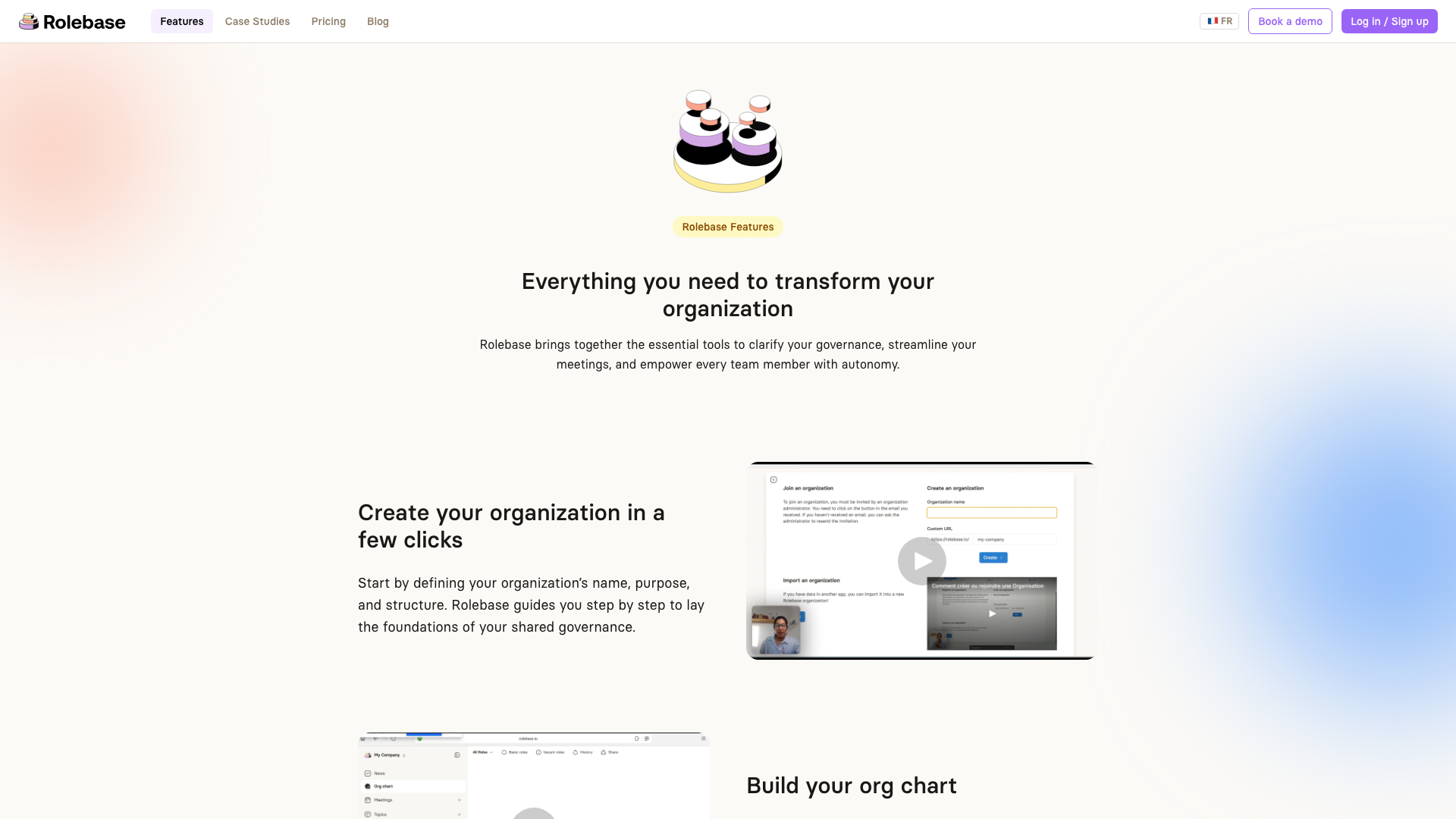
In Rolebase a meeting belongs to a role and consists of ordered steps. Five step types exist: free note, checklist, indicators, tasks and discussions. When you create an organisation on the Holacracy model, Rolebase installs a triage meeting template chaining those five steps on a weekly sixty-minute recurrence, next to a monthly ninety-minute governance template.
The mapping onto the seven constitutional steps is partial, and it helps to know that before configuring a template.
- The free note covers both the check-in round and the closing round. Put two of them in the template, one at each end.
- The checklist and indicators steps pull the role's checklist and indicators into the note. Everyone ticks inside the note during the session, and the state of the boxes stays attached to that meeting.
- The discussions step acts as the agenda. You attach the role's discussions in the order you want, reorder them by drag and drop, and the notes taken under each one flow back into that discussion's thread.
- The tasks step opens the role's kanban inside the meeting, with a status and assignee filter that persists from one session to the next.
Rolebase leaves timing and facilitation to the people in the room. The only time cue is the end-meeting button, which animates once the scheduled end has passed. That restraint fits article 3.2 well enough, since allocating time there is a matter of the Facilitator's judgement.
- Meetings repeat on a recurrence rule, sync with Google Calendar or Office 365, and export as an iCal feed.
- A new session picks up the previous one's notes in a single click, which saves rebuilding the checklist and the indicator list every week.
- Tasks created during the session carry a role, an assignee and a due date, then move through a kanban or a list view.
- An item calling for a collective decision becomes a proposal inside the matching discussion, with a vote by consent, unanimity or majority. A poll covers the lighter calls.
- When the meeting ends, the report gathers the date, the participants with their attendance, the notes from each step and the tasks created. One button generates a one-paragraph summary that you review before saving it.
The guide on running your first meeting covers the full path, and the one on raising and processing a tension shows how an item turns into an action, a decision or a governance proposal.
Frequently asked questions
What is a tactical meeting?
A tactical meeting moves a circle's current work forward. Participants read out their recurring actions, their metrics and their progress, then process an agenda built in the room. Each item is settled by a request aimed at a person or at a role. The Holacracy Constitution devotes its article 3 to it, and the nickname "triage meeting" comes from the "Triage Items" step.
What are the steps of a tactical meeting?
Article 3.2 of the Holacracy Constitution 5.0 sets seven, in this order: Check-in Round, Checklist Review, Metrics Review, Progress Updates, Build Agenda, Triage Items and Closing Round. A Policy of the circle may define a different process or amend this one.
How does it differ from a governance meeting?
A tactical meeting moves current work forward and leaves the structure alone. A governance meeting changes that structure, by creating, amending or removing roles and policies, and by holding elections. A tactical item that calls for a standing rule goes to governance, because article 5.2 reserves that kind of decision for it.
How long should a tactical meeting last?
Sixty minutes suits a circle of eight, with roughly twenty-five minutes for triage. The Constitution leaves both duration and frequency open for this meeting type, unlike the governance meeting, which article 5.4.2 ends the moment it hits its scheduled length. The Facilitator allocates time across the agenda and cuts off any item that overruns its share.
Do you need a timekeeper?
The Holacracy Constitution gives time management to the Facilitator, inside the triage step, and it defines four roles only: Circle Lead, Facilitator, Secretary and Circle Rep. The timekeeper comes from ordinary facilitation practice. A team that wants one anyway does well to state that the timekeeper watches the clock while the Facilitator decides when to cut.
Who captures the decisions and the actions?
The Circle's Secretary is accountable for capturing and publishing the outputs of the regular tactical meetings. When someone else convenes the meeting, that person facilitates and captures, or hands both tasks to a volunteer or an appropriate Role. What leaves the session amounts to next-actions, accepted projects and permissions to impact a domain.
Can you run tactical meetings without adopting Holacracy?
Yes. Three mechanisms carry most of the result and can be adopted separately. Build the agenda in the room with short labels, keep the metrics and checklist reviews at the level of readouts, and settle each item with a named request rather than a group discussion. A team applying those three rules sees its meetings shorten without ratifying any constitution.
What to take away
The tactical meeting rests on one idea. Take stock fast, then process items one at a time, each through a request aimed at a named person who answers with an action, a clarification or a reasoned refusal. The seven steps of article 3.2 exist to protect that idea from the two habits that kill it, commentary that swells the readouts and group debate that replaces the request.
A team new to the format takes three or four sessions to find its rhythm. What changes then shows up in the triage numbers. The count of items processed per hour doubles, and topics that had been drifting for weeks start leaving the room with a name attached.


