
Meeting Overload: The Why According to a Researcher and Our 5 Tips to Fight It
Discover the causes of meeting overload in the workplace through the research of Philippe Silberzahn, a researcher at École Polytechnique. Reduce the cost of unnecessary meetings for your company with our five practical tips.
September 18, 2023
Meeting overload is a problem that plagues many companies today. If you have ever experienced a week filled with more than 20 hours of meetings, you understand how it can become a real nightmare, especially when you are trying to immerse yourself in tasks that require deep concentration.
It has been proven that it takes an average of 23 minutes to regain focus after a distraction, making the frequent interruptions caused by meetings even more concerning.
In this article, we will explore meeting overload in depth, where it originates in the workplace, why companies need to address it strategically, and we will share our five practical tips to fight it.
The Plague of Meeting Overload
Meeting overload, a plague that may seem minor at first glance, is actually a significant problem in many companies. It reflects an overabundance of unproductive meetings that tend to become the norm in many work environments. It may seem harmless, but the costs associated with this phenomenon are far from negligible.
Philippe Silberzahn, a researcher at École Polytechnique and a specialist in business transformations facing uncertainty and disruption, has shed welcome light on the scale of meeting overload. His research and observations have highlighted how many companies struggle to find effective solutions to mitigate this plague.
This problem becomes even more significant when considered from a cost perspective. It is directly linked to a major expense center within organizations: human resources. To get an idea of the financial impact of meeting overload, let's take a concrete example: a company with 200 employees, where each employee spends an average of 2 hours in meetings every week. The cost of these inefficient meetings amounts to over one million euros for the company by the end of the year. Imagine what that sum could represent if it were invested more wisely in projects or initiatives that benefit the company.
It is essential to recognize the scale of expenses related to meeting overload and the negative impact it can have on the overall profitability and productivity of the company. These costs go well beyond the hours spent in meeting rooms. They also include lost opportunities, project delays, employee frustration, and reduced operational efficiency.
The Root Causes of Meeting Overload
Philippe Silberzahn identified two root causes that fuel meeting overload:
1. Fear of Failure
Fear of failure is one of the most prominent root causes of meeting overload in the workplace. It is based on a seemingly rational idea: meetings are a way to ensure that the team communicates enough to avoid embarking on a project that could potentially lead the company straight into a wall. With this in mind, team members gather frequently to discuss the various facets of a project in detail and to make collective decisions.
However, this approach, although well-intentioned, can have adverse effects on overall efficiency. In reality, an overabundance of meetings can slow down progress and hinder productivity. Here is why:
First, meetings consume valuable time. The hours spent in meetings are hours lost for completing actual tasks. The frequent interruptions caused by meetings fragment the workday, requiring longer periods to effectively dive back into complex tasks, as research suggests it takes an average of 23 minutes to regain optimal focus after a distraction.
Additionally, the multiplication of meetings can lead to an uneven distribution of time and attention. Projects that require particular attention and deep thinking can be pushed aside in favor of less crucial meetings. This can create an imbalance in time and energy management, with harmful consequences for the quality of work produced.
Moreover, decisions made during meetings can sometimes be influenced by political or emotional considerations rather than strictly data-driven and fact-based criteria. This dynamic can lead to sub-optimal decision-making or push projects in the wrong direction.
The frustration and sense of wasted time generated by excessive meetings can have a negative impact on employee motivation and engagement. Employees may feel less valued and less invested in their work, which can lead to decreased productivity and job satisfaction.
Ultimately, fear of failure, while it may seem like a valid justification for organizing frequent meetings, can have detrimental consequences on efficiency and productivity in the workplace. It is essential to find a balance between the communication needed to avoid mistakes and the harmful effects of meeting overload. Solutions should aim to maximize productive work time, promote informed decision-making, and maintain employee motivation at the highest level.
2. The Need for Reassurance
The need for reassurance is another important facet of meeting overload in the workplace. It stems from the perception that receiving feedback from colleagues in real time during meetings is often more comforting than waiting for asynchronous comments. This preference for real-time feedback can be explained by several factors.
First, in-person communication is generally perceived as more direct and personal. When a colleague gives face-to-face feedback, they can express themselves more nuancedly, explain their viewpoints, and immediately respond to questions or concerns. This immediate interactivity creates a sense of closeness and mutual understanding that can be reassuring for those who need to feel supported in their work.
Furthermore, real-time feedback often allows problems or misunderstandings to be resolved quickly. When questions or concerns arise during a meeting, they can be addressed immediately, preventing potential problems from escalating or disrupting subsequent work. This responsiveness can strengthen the sense of security within the team.
However, it is important to note that the preference for real-time feedback can also have drawbacks. It can encourage frequent interruptions and an overabundance of meetings, which can disrupt concentration and productivity. Additionally, immediate reactions can sometimes be emotionally charged, which can complicate communication in cases of disagreements or critical feedback.
To mitigate the need for reassurance while maintaining effective communication, it is essential to find a balance between real-time and asynchronous feedback. Digital communication tools, such as online collaboration platforms and project management tools, can facilitate asynchronous communication while allowing team members to take the time needed to formulate thoughtful responses.
This need for reassurance, which drives a preference for real-time feedback, is another factor contributing to meeting overload in the workplace. While this preference can offer some comfort, it can also lead to disruptions and inefficiencies. Finding the right balance between real-time and asynchronous communication is essential to maximize productivity while meeting the needs of those who seek personal support in their work.
Our 5 Practical Solutions Against Meeting Overload
To effectively combat meeting overload, it is essential to address the underlying problems that fuel it. Here are five practical tips to achieve this:
1. Rethink Your Approach to Meetings
Rethinking your approach to meetings is a crucial step in effectively fighting meeting overload in the workplace. Instead of scheduling meetings by default, it is essential to ask yourself whether they are truly necessary. This proactive reflection can bring significant benefits to your organization.
A first step is to consider alternatives to traditional meetings. For example, for routine updates or simple communications, written messages can often suffice. Instant messaging tools, emails, or internal communication platforms can be used to share information effectively without requiring an in-person meeting.
Additionally, quick calls can be a valuable alternative to formal meetings. If a discussion requires a quick clarification or an immediate answer, a phone call or a short video conference can be more relevant and less time-consuming than a meeting involving more people.
For projects, project management tools, such as task tracking systems and project management platforms, can play a key role in reducing the need for frequent meetings. Relevant information can be documented and shared through these tools, allowing team members to track progress and collaborate asynchronously.
Finally, using video recordings, such as Loom, can also be an effective strategy for sharing information in a visual and engaging way. These recordings can be viewed at any time by team members, eliminating the need to coordinate time slots for live meetings.
By adopting these alternative approaches, you can reduce the number of non-essential meetings, allowing your team to save time and focus on more productive tasks. This will help mitigate meeting overload and improve the overall efficiency of your company.
2. Establish a Clear Meeting Agenda
Establishing a clear meeting agenda is a fundamental step in making meetings more effective and combating meeting overload. When you take the initiative to organize a meeting, it is essential to define clear and specific objectives for that particular meeting. This practice helps steer the discussion toward concrete outcomes and ensures that each participant understands the overall objective of the meeting.
- What is the agenda? List the topics or points to be discussed during the meeting. Make sure each point is related to the meeting objectives.
- What are the responsibilities? Clearly indicate what is expected of each participant. Who should present information? Who is responsible for making decisions? Who should contribute to problem-solving?
- Notify about required documents or preparations. If specific documents or preparations are required before the meeting, make sure participants are informed in advance so they can prepare adequately.
By sharing this agenda with participants before the meeting, you allow everyone to prepare adequately and bring relevant contributions. This reduces the risk of discussion drift and wasted time on irrelevant topics.
Ultimately, a clear meeting agenda helps keep the meeting on track, maximize its effectiveness, and effectively fight meeting overload by ensuring that time spent in meetings is used productively to achieve specific objectives.
This is something we strive to make accessible with Rolebase by providing access to meeting templates:
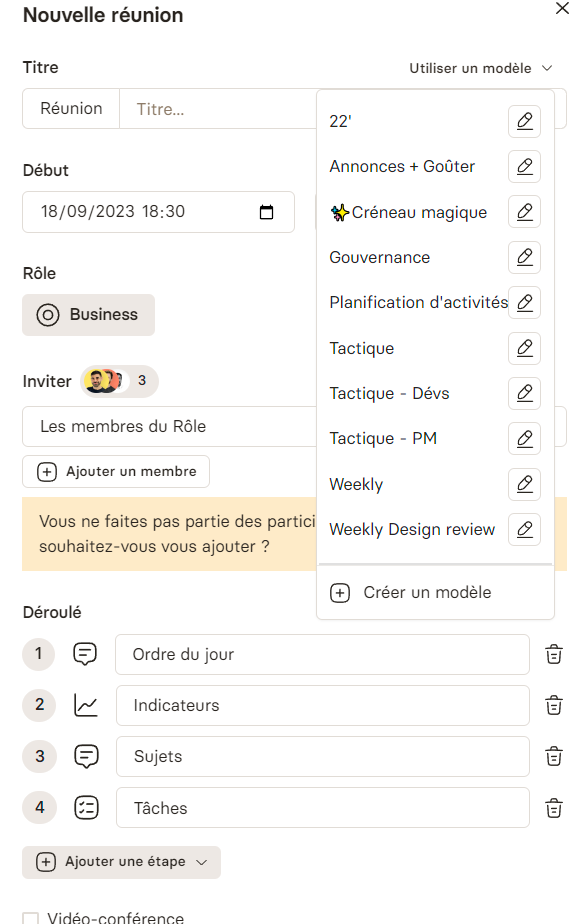
Meeting flow and templates in Rolebase
We wanted to make it easy for teams to follow a structured framework to simplify their organization as much as possible.
3. Limit Meeting Duration
Limiting meeting duration is an essential practice for combating meeting overload and promoting productivity in the workplace. An effective meeting does not need to stretch unnecessarily over a long period. On the contrary, by setting strict time limits, you encourage focus, relevance, and efficiency within the team.
It takes an average of 52 minutes for employees to disengage from a meeting and lose all concentration, letting themselves get distracted. They end up responding to asynchronous messages while only half-focused. It is the worst of both worlds.
It is important to recognize that time is a valuable resource for all meeting participants. Every minute is a resource that could be used to complete tasks, make decisions, or move projects forward. Therefore, respecting everyone's time is a sign of mutual respect and effective resource management.
When planning a meeting, carefully evaluate the content to be discussed and determine the time needed to address each point adequately. If a topic can be covered in 30 minutes instead of an hour, do not hesitate to shorten the meeting accordingly. Make sure the agenda is clear and that discussions remain focused on essential points.
To maintain time discipline during the meeting, appoint a timekeeper (we call them the facilitator) or use a timer to ensure each discussion point is covered within the allotted time. By setting strict time limits, you encourage participants to focus on priorities, avoid digressions, and maximize the efficiency of the meeting.
Often, when a meeting runs over, it delays the next one, triggering a sort of snowball effect of delays.
Ultimately, limiting meeting duration saves valuable time, maintains participant engagement, and reduces frustration associated with never-ending meetings. This practice fosters a culture of time respect within the organization and contributes to fighting meeting overload by promoting more effective and focused meetings.
4. Only Invite Relevant People
Inviting only relevant people to a meeting is a crucial step in avoiding meeting overload and ensuring that each meeting is productive. It is essential to make sure that only those whose presence is necessary are invited, in order to avoid wasting time and resources.
However, it can be tricky to determine who is relevant for a given topic, especially when areas of expertise overlap or when contribution needs vary. To avoid unintentionally excluding important stakeholders, it is helpful to establish a company culture that encourages transparency and flexibility.
It can be beneficial to create internal guidelines or policies that clearly indicate it is acceptable for participants to leave a meeting if they feel they are not adding value to a given topic. This allows participants to make informed decisions about their attendance and promotes a more efficient approach to meetings.
Additionally, the concept of circles and circle leaders, as mentioned, can prove invaluable. This approach allows you to bring together specifically the people involved in a particular project or initiative, ensuring the relevance of each participant's presence. By avoiding the scheduling of unnecessary meetings and optimizing the composition of work teams, this approach greatly contributes to fighting meeting overload.
Ultimately, inviting relevant people to a meeting is a subtle balance to find, but by establishing appropriate practices and company culture, it is possible to maximize the value of meetings while avoiding the inconveniences of unjustified attendance.
5. Designate a Facilitator
Designating a facilitator is an effective strategy for improving meeting management and fighting meeting overload. The facilitator's role is to ensure that the meeting runs smoothly, efficiently, and within the allotted time. Here is how a facilitator can contribute to more productive meetings:
- Time management: The facilitator is responsible for monitoring the time allocated to each agenda item. They ensure that discussions stay within the set time limits, which helps keep the meeting on track and avoid overruns that can lead to never-ending meetings.
- Preparation reminders: The facilitator can remind participants of what is needed for the meeting, such as documents to bring or specific preparations to complete. This ensures that everyone is ready to contribute meaningfully.
- Managing interruptions: In case of interruptions or deviations from the current topic, the facilitator steps in to bring the discussion back on track. This helps prevent unnecessary digressions and maintains the relevance of exchanges.
- Encouraging participation: The facilitator can also play an active role in encouraging participation from all team members. They ensure that everyone has the opportunity to speak and contribute to the discussion, which promotes more informed decisions.
- Recap and action items: At the end of each agenda item, the facilitator can summarize the decisions made, the actions to be taken, and the responsibilities assigned. This ensures clarity and traceability of meeting outcomes.
By designating a competent facilitator, you can significantly improve the management of your meetings, reduce meeting overload, and ensure that each meeting is a productive time investment for all participants. This approach contributes to better use of company resources and a more effective meeting culture.
Building a Culture Against Meeting Overload, for Meetings That Deliver Value
Role Based Management offers an innovative approach to managing roles, responsibilities, and collaboration within your company. By assigning clearly defined roles, facilitating meetings, and structuring actions to be taken, RBM promotes transparent governance and informed decision-making.
It is an effective way to support change and create an organizational structure where employees feel comfortable collaborating and use meetings strategically to create value.


