
Meeting overload: what the research actually says
How much time meetings really take, what they cost in focus, and the changes that lighten the calendar while keeping teams coordinated.
October 7, 2023
Updated on July 28, 2026
- Executives spend nearly 23 hours a week in meetings, up from less than 10 hours in the 1960s (Perlow, Hadley and Eun, Harvard Business Review, 2017).
- Getting back to an interrupted task takes 25 minutes and 26 seconds on average, after passing through 2.26 other topics (Mark, González and Harris, CHI 2005). The widely quoted 23 minutes and 15 seconds appears in no study.
- Meeting overload is a symptom. Philippe Silberzahn reads it as protection against the fear of being wrong, sustained by the belief that a manager must have an answer for everything.
- Two changes carry most of the result: an agenda built in the room by the participants, and a role that decides alone on its own domain.
The French call it réunionite, and the joke travels well. The suffix comes from medicine, the one in bronchitis and appendicitis, where it marks an inflammation. Holding meetings looks harmless until the volume turns it into a condition.
The word is funny, the load is measurable. The figures most often repeated on this topic trace back to sources nobody can find, while the research on meetings is plentiful, dated and easy to cite.
How much time meetings actually take
Steven Rogelberg, Cliff Scott and John Kello published a review of meeting research in the Winter 2007 issue of the MIT Sloan Management Review. The average employee spends around 6 hours a week in scheduled meetings, senior managers close to 23 hours. The authors also note that meeting attendance for executives doubled between the 1960s and the 1980s.
Ten years later, Leslie Perlow, Constance Noonan Hadley and Eunice Eun land on the same order of magnitude in the Harvard Business Review of July-August 2017. Executives spend nearly 23 hours a week in meetings, up from less than 10 hours in the 1960s. Two teams, two methods, one result. A day and a half a week goes into meetings at the top of the organization.
Remote work pushed the curve further. Between February 2020 and February 2021, Microsoft measured a 2.5x increase in time spent in Teams meetings worldwide, and an average meeting length that grew from 35 to 45 minutes. Those numbers come from the Work Trend Index published on 22 March 2021, based on platform usage signals. Our advice on remote meetings starts from that shift.
The cost that never shows up on the calendar
A meeting costs more than its own duration. Michael Mankins, a Bain partner, described in the Harvard Business Review of 29 April 2014 a large organization whose analysts traced the full footprint of a single weekly executive committee meeting. Counting the cascade of preparatory meetings that fed its agenda, the company spent 300,000 hours a year on it.
The other half of the bill is paid in focus. Gloria Mark, Victor González and Justin Harris observed 24 information workers minute by minute and published their measurements at the CHI conference in 2005. When someone resumes an interrupted task on the same day, an average of 25 minutes and 26 seconds goes by, and they have moved through 2.26 other topics in between. The 23 minutes and 15 seconds figure repeated across hundreds of articles appears nowhere in that work.
Gloria Mark continued with Daniela Gudith and Ulrich Klocke at CHI 2008. Interrupted people finish their task faster, with no measurable loss of quality, and they pay for that catch-up in stress, frustration, time pressure and perceived effort. The calendar shows only the slots. The rest plays out in the half hour after each meeting, and that half hour belongs to the quiet drain on a team's energy.
Microsoft put physiological measurements on the same effect. Its Human Factors Lab fitted 14 people with EEG caps and ran them through two consecutive Mondays: four thirty-minute meetings back to back, then the same four meetings separated by ten-minute breaks. Without breaks, beta wave activity associated with stress climbs across the two hours, spiking at every transition from one meeting to the next. With breaks, it comes back down between sessions. The results are dated 20 April 2021.
At company scale, Bain measures the bill differently. Across 300 companies with more than 500 million dollars in revenue, the average one loses a quarter of its productive capacity to organizational friction, unnecessary meetings and duplicated coordination. That figure comes back in our piece on the structural problems of hierarchy, because the cause rarely sits in the calendar itself.
Five signals that give meeting overload away
| Signal | What it tells you | What fixes it |
|---|---|---|
| A recurring meeting with no agenda | The slot exists before the subject does | Build the agenda in the room, and cancel when the list stays empty |
| Participants answering messages during it | The subject falls outside their roles | Invite the roles concerned, and let the others go |
| The same topic returning session after session | The previous decision stayed spoken | Record the decision in the role that made it |
| Two teams handling the same topic separately | Past meeting notes are impossible to find | Make meeting minutes searchable |
| A session running ten minutes over | The agenda exceeds the time available | Stop on time and carry the rest over |
Overrun deserves its own mention, because it spreads. Ten minutes late starts the next meeting late, which pushes the third one, and the day ends with an hour of debt nobody decided to take on. It is also the first thing a team can fix while changing nothing else.
Why meetings multiply
In many companies, calling a meeting proves you take a subject seriously. The slot works as a social signal, whatever gets decided inside it. Nobody defends that logic out loud, and everybody follows it, because the colleague who handles a topic in writing reads as less committed than the one who gathers eight people for an hour.
Philippe Silberzahn describes a deeper mechanism in a post dated 3 October 2022, titled "Comment (ne pas) lutter contre la réunionnite". His argument fits in one line: meeting overload is a symptom, and attacking meetings themselves treats the fever rather than the infection. The cause he identifies is fear among managers, fear of making a mistake or of having no answer in front of a superior. The meeting becomes the protection they find, sustained by a belief he states plainly, that a manager must have an answer for everything. An internal charter capping meetings at thirty minutes leaves that belief untouched.
Another force pushes the same way, and this one is legitimate. Immediate feedback reassures more than a written comment that may arrive tomorrow. Face to face, people qualify their point, answer objections, and leave with a clear read on what everyone thinks. That need is real, and it produces comfort meetings whose agenda fits in a sentence.
Then there is the fog around who decides. When nobody knows who has the call on a subject, gathering everyone becomes the safest way to avoid deciding alone. An organization where each role holds a domain it decides on removes part of those invitations, because the question "am I allowed to?" stops coming up.
What actually lightens the calendar
Sort before booking the slot
A progress update reads perfectly well in writing. A two-minute clarification gets settled by a two-minute call. An explanation that needs a screen gets recorded in five minutes and watched whenever people want. Meetings keep what needs a live exchange, meaning trade-offs, objections and subjects where positions move while people talk.
One question does the sorting. What will be true at the end of this meeting that is not true now? A vague answer marks a slot to drop.
Protect meeting-free days
Benjamin Laker, Vijay Pereira, Pawan Budhwar and Ashish Malik studied 76 companies of more than 1,000 employees, operating across more than 50 countries, which had introduced one to five meeting-free days per week. Their findings, published in the MIT Sloan Management Review on 18 January 2022, show gains in autonomy, cooperation and perceived stress, with the best results at three meeting-free days a week.
The format works because it moves the burden of proof. Booking a meeting on Tuesday becomes something you justify, instead of a calendar reflex.
Separate structure from ongoing work
Many meetings run long because they mix two materials. People unblock the week's work, and they also discuss who should own what. The first calls for quick requests between two people, the second calls for a decision process.
The tactical meeting moves ongoing work forward in seven steps, including a triage where each item is settled by a request addressed to a named person. The governance meeting changes the structure, creates a role, amends an accountability, sets a policy. Both articles cover the flow, the timing and what the facilitator cuts.
Let participants build the agenda
An agenda sent the day before has two side effects. It ages within twenty-four hours, and it invites everyone to sharpen arguments rather than listen. The Holacracy constitution has the agenda built during the meeting, as three-word labels, with no explanation and no discussion. The facilitator then picks the processing order.
That mechanism can be adopted on its own, in any team meeting. It shortens the session because it makes the number of subjects visible against the time available, from the first minute.
Set the duration and stop there
An item that fits in thirty minutes takes an hour when the slot lasts an hour. Agile stand-ups run ten to fifteen minutes, standing, and that is enough to surface the blockers of the day.
Booking 25 and 50 minutes instead of 30 and 60 frees the break that the Microsoft EEG study makes visible. Five to ten minutes between sessions is enough for stress-related activity to come back down, and for someone to write up what was just decided.
When a side topic surfaces mid-session, the useful reflex is to create a task for the person concerned, who prepares the item and puts it on a later agenda. The topic keeps a written trace, and the current session keeps its time.
Invite the roles concerned
A broad invitation feels prudent and costs a lot. Eight people for a subject that concerns three is five hours of work spent for one hour of useful meeting.
Organizing by roles makes that call mechanical. Everyone attends the meetings of the roles they hold, and the attachment is written in the org chart rather than negotiated each time. One explicit rule completes the setup. Leaving a session when you add nothing to it becomes acceptable behaviour, as long as the team has said so once and for all.
Write down what comes out of the session
A decision that stays spoken returns to the agenda two months later. Meeting minutes that fit in ten lines, with the decisions made, the tasks created and their owners, end that repetition. Our guide to productive meetings walks through the same discipline point by point.
The second effect matters just as much. Searchable minutes let anyone check that a subject has already been handled before booking a meeting about it, which removes duplicates between teams.
Running these meetings in Rolebase
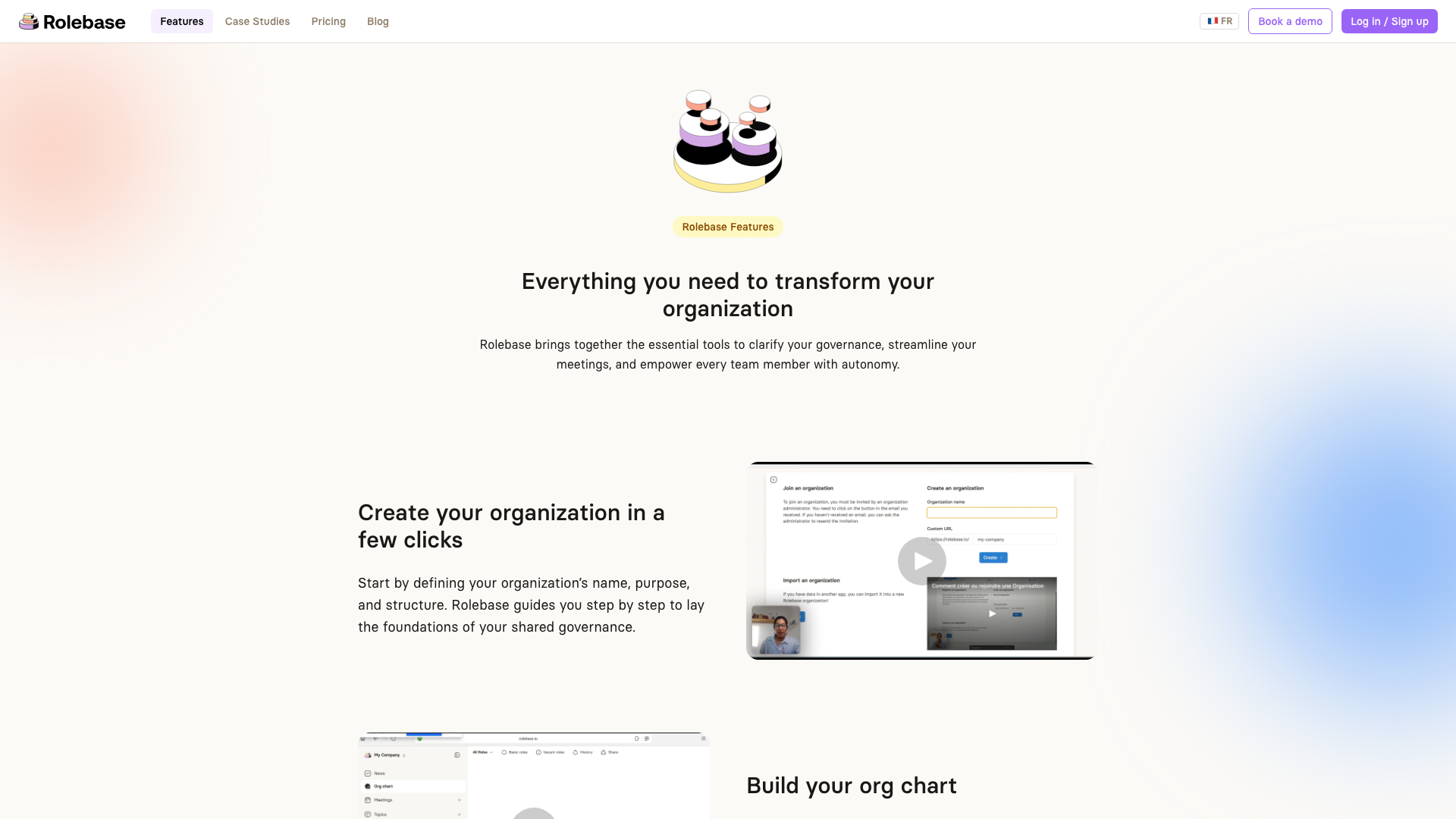
In Rolebase, a meeting belongs to a role and is made of ordered steps. Five step types exist: speaking round, discussions, tasks, checklist and indicators. A meeting template stores a reusable sequence, which lets you keep a full tactical format and a shorter governance format side by side.
- Meetings repeat on a recurrence rule, sync with Google Calendar or Office 365, and export as an iCal feed.
- The discussions step serves as the agenda. You attach the role's discussions in the order you want, and notes taken under each one flow back into its thread.
- Tasks created during the session carry a role, an assignee and a due date, which lets a side topic leave the room without getting lost.
- When the meeting ends, a panel invites you to write the minutes. A button generates a first draft from the notes taken during the session, which you review and edit before saving.
- Global search covers members, roles, discussions, meetings, tasks and decisions, so you can find how a subject was handled before booking another slot.
The guide to running your first meeting walks through the whole path. The features page shows the rest, and the free plan covers up to five active members.
Frequently asked questions
What is meeting overload?
It describes an accumulation of meetings experienced as unproductive in a company's daily life. French has a word for it, réunionite, listed in the Trésor de la langue française as colloquial, under the entry for réunion, meaning a mania for meetings. The suffix comes from medicine, where it marks an inflammation.
How much time do people spend in meetings?
Rogelberg, Scott and Kello reported around 6 hours a week for an employee and close to 23 hours for a senior manager in the MIT Sloan Management Review in 2007. Perlow, Hadley and Eun found nearly 23 weekly hours for executives in the Harvard Business Review in 2017, up from less than 10 hours in the 1960s. Between February 2020 and February 2021, Microsoft measured a 2.5x increase in Teams meeting time.
How long does it take to get back to work after a meeting?
Gloria Mark, Victor González and Justin Harris observed 24 information workers and published their measurements at the CHI conference in 2005. Resuming an interrupted task on the same day takes an average of 25 minutes and 26 seconds, after moving through 2.26 other topics. The 23 minutes and 15 seconds figure widely quoted online appears in none of those publications.
How do you know whether a meeting is necessary?
Ask about the outcome. What will be true at the end of this session that is not true now? Information sharing reads in writing, a short clarification gets settled by a call, a demonstration gets recorded. Meetings keep the trade-offs, the objections and the subjects where positions move while people talk.
Do meeting-free days really work?
Laker, Pereira, Budhwar and Malik studied 76 companies of more than 1,000 employees across more than 50 countries, applying one to five meeting-free days per week. Their study in the MIT Sloan Management Review of 18 January 2022 reports gains in autonomy, cooperation and perceived stress, with the best results at three days a week.
How do you cut meetings while staying coordinated?
Replace the slot with a rule. A role that decides alone on its domain removes approval meetings, an agenda built in the room removes empty sessions, and searchable minutes remove the meetings that restate what was already decided. Coordination then runs through written structure rather than through simultaneous presence.
What to take away
The numbers circulating about meeting overload matter less than the mechanism. Meetings multiply when nobody knows who decides, and they thin out when each role holds a domain and every decision gets written down.
A team that wants to act this week has two immediate levers. Stop every session at the scheduled time, and have the participants build the agenda at the start of the session. The rest follows, and it follows more easily once the calendars have room to breathe.


