
Circle Lead: what a circle's leader actually decides
Lead Link became Circle Lead in 2021. What the constitution grants the role, where its authority stops, and how a manager handles the switch.
April 14, 2025
Updated on July 28, 2026
- Version 5.0 of the constitution, published in June 2021, renamed Lead Link to Circle Lead and Rep Link to Circle Rep.
- A Circle Lead assigns the circle roles, resolves priority conflicts and covers vacant roles. The six fixed accountabilities the Lead Link carried in version 4.1 are gone from the text.
- Structural changes run through the governance process, where the Circle Lead counts as one voice among the circle members.
- A circle may strip its own Circle Lead of any authority by placing it on another role, under article 1.4.5.
A manager moves to holacracy and becomes a Circle Lead. Three weeks later a developer in the circle tells him the database choice belongs to her role, and that his opinion carries the same weight as anyone else's. He finds this disorienting, and she is right on the substance.
The role holds real authority, and the constitution spells out exactly what that authority covers. It covers far less ground than a manager's job. This article walks through the list article by article, then asks the uncomfortable question about power quietly gathering around the one figure left standing.
Lead Link became Circle Lead in 2021
HolacracyOne published version 5.0 of the constitution in June 2021. It renamed two roles at once. Lead Link became Circle Lead. Rep Link became Circle Rep.
The vocabulary matters because most articles, training decks and software menus still say Lead Link, five years after the text stopped using it.
Version 5.0 names four constitutional roles: Circle Lead, Circle Rep, Facilitator and Secretary. Lead Link and Rep Link belong to version 4.1 and earlier. "First Link" and "Second Link" appear in none of them.
The content changed along with the name. In version 4.1, Appendix A gave the Lead Link six written accountabilities: structuring the circle's governance, assigning partners and monitoring fit, allocating resources, setting priorities and strategies, defining metrics, and removing constraints on the super-circle. It also gave the role a domain, role assignments within the circle. Version 5.0 deleted that list. The Circle Lead Role now holds the purpose of the broader role that contains it, plus whichever accountabilities of that role no other role in the circle covers yet.
What a Circle Lead decides
Filling a role makes you its Role Lead. The inside of that role is a circle, and you automatically become its Circle Lead. The constitution attaches four authorities to that position.
| Article | What the Circle Lead may do |
|---|---|
| 1.4.1 | Assign any role in the circle to anyone willing to fill it, including several people at once, and revoke an assignment at any time |
| 1.4.1 | Narrow an assignment to a specific context, where each focus then behaves as a separate role |
| 1.4.2 | Automatically hold any unfilled role in the circle, for as long as it stays unfilled |
| 1.4.3 | Resolve priority conflicts across roles, and publish one or more strategies to guide those calls |
| 1.4.4 | Reroute any external governance reference aimed at the circle toward a specific role inside it |
The assignment authority is exclusive. Article 1.4.1 states that nobody other than a Circle Lead may assign or revoke a role in the circle, until the circle delegates that control to another role or process.
Priorities bite harder than they look. Article 2.3 (c) requires every partner to treat a circle's official priorities as more important to the organization than their own judgment of what matters. A circle's official priorities are the ones a Circle Lead defines. So a model built to distribute authority still keeps one person able to tell a whole team what comes first.
Where that authority stops
Structure is out of reach. Article 5.2 lists the only valid outputs of a governance process: defining, amending or removing the circle's roles and policies, moving roles and policies between a circle and a sub-circle, and holding elections for elected roles. Creating a role or changing an accountability therefore runs through the governance meeting. The Circle Lead sits there as a circle member alongside the other Role Leads, article 5.1, and holds one voice. The facilitator testing an objection may only judge whether the objector reasoned through each criterion, article 5.3.3, so the merits escape the facilitator and the Circle Lead alike.
How the work gets done belongs to whoever does it. Article 4 gives every Role Lead the authority to take any action or make any decision that enacts their role's purpose or accountabilities, as long as no constitutional rule breaks. The developer from the opening is right. A Circle Lead who dictates a technical choice inside someone else's role has stepped outside his own.
The upward channel is closed to him. Article 5.1.1 puts it plainly: anyone serving as a Circle Lead for a circle may not also serve as its Circle Rep. Carrying the circle's tensions into the broader circle goes to someone else, elected by the circle.
Employment sits outside the frame. Version 5.0 says nothing about salary, hiring or firing. Revoking an assignment leaves the person in the organization, with their other roles intact. What happens to their contract falls under whatever systems predate ratification, which the preamble keeps in force.
The circle can also disarm him. Article 1.4.5 lets a circle remove any accountability, domain, authority or function from its own Circle Lead Role, either by placing it on another role or by defining an alternate means of enacting it. Exactly two protections remain: the circle must keep the Circle Lead Role itself, and must keep its purpose as written.
The anchor circle has no Circle Lead at all, unless a policy says otherwise. That is article 1.3.3, and it regularly surprises founders who have just adopted the model.
A Circle Lead's Monday morning
9:10. The Support role has been vacant since someone left. Article 1.4.2 makes the Circle Lead its Role Lead by default, so he either handles the tickets himself or assigns someone before the day ends.
9:40. Two roles want the same week of engineering time. He calls it, as article 1.4.3 allows. His call covers the order of play, and how the work happens stays with the role doing it.
10:30. Someone asks him to approve a redesign of the pricing page. That domain belongs to the Marketing role. His answer is one sentence and one role name.
2:00 pm. He notices two roles tripping over each other on overdue invoices. He adds an agenda item for the next governance meeting. In session, his proposal goes through the same six steps as anyone else's.
5:00 pm. He rereads the strategy he published last month. Three decisions this week contradict it, so he rewrites it and tells the circle.
A Circle Lead's day holds a lot of assignments and priority calls, and very few approvals.
How someone becomes Circle Lead
The role passes down by assignment. A circle's Circle Lead is whoever fills the broader role one level up, and the Circle Lead of that level assigned them under article 1.4.1. The chain runs all the way up to the anchor circle.
The other three constitutional roles come the other way. Circle Rep, facilitator and secretary arrive through the integrative election process, covered in our piece on elections without candidates. Version 4.1 barred the Lead Link from being elected facilitator or Rep Link. Version 5.0 lifted the first bar and kept the second.
A circle can also have several Circle Leads. It only takes the broader role being filled by several people, which article 1.4.1 explicitly allows. Article 5.3.6 handles the consequence by naming "the first one to declare themselves" when a surrogate facilitator or secretary is needed.
Manager and Circle Lead, side by side
| Traditional manager | Circle Lead | |
|---|---|---|
| Who decides how work is done | The manager approves | The Role Lead, article 4 |
| Who changes the scope | The manager, with HR | The circle, in a governance meeting |
| Who assigns people | The manager | The Circle Lead, article 1.4.1 |
| Who resolves priority clashes | The manager | The Circle Lead, article 1.4.3 |
| Who covers a vacancy | Recruitment, months later | The Circle Lead, immediately, article 1.4.2 |
| What follows the person | Title and grade | A revocable assignment, with no effect on the contract |
| The team's recourse | The manager's manager | A governance proposal, or the Circle Rep |
The switch stays uncomfortable for a few months. Technical questions keep landing on the former boss, and the right answer becomes the name of a role. Requests for a ruling keep landing too, and a good share of them now belong in governance. The most expensive habit is going quiet in meetings to make room for others, because a silent Circle Lead lets his own tensions pile up while the circle assumes everything is fine.
When power gathers back around the Circle Lead
The strongest criticism of the model aims squarely at this role. Steve Denning described holacracy in Forbes on 23 May 2015 as "hierarchy on steroids, albeit not a hierarchy of people with the title of 'bosses'". Circles stay nested, and the assignment chain does run down from the top.
French research on the liberated company sees the same movement in a neighbouring setting. Patrick Gilbert, Ann-Charlotte Teglborg and Nathalie Raulet-Croset, writing in Gérer & Comprendre in March 2017, found that flattening the hierarchy strengthens the leader's standing. Once the middle layers go, every arbitration lands on the one figure left. In holacracy that figure at least has a name and a written list of authorities, which makes it arguable.
The constitution also keeps an escape hatch pointing upward. Article 5.5.2 (d) lets the facilitator of the super-circle, during a process breakdown, assign an additional Circle Lead whose decisions override any conflicting ones. The mechanism is temporary and bounded, and it exists.
The counterweight sits in two articles. Article 1.4.5 lets a circle move its Circle Lead's authorities onto another role, for instance handing assignments to a Staffing role. Article 5.1.1 gives the circle a voice upward that the Circle Lead is barred from holding.
A circle that leaves both articles dormant ends up with a manager under a new name. That setup is common, and one number gives it away: how many proposals the circle processed in governance over the year. A circle that produced none renamed its authority instead of distributing it.
Taking the role without rebuilding the old one
- Write the purpose and accountabilities of the broader role before assigning anyone. The Circle Lead inherits whatever no other role covers, so a vague broader role hands him the entire job.
- Publish the strategies instead of keeping them in your head. A written strategy can be argued with in governance. An implicit preference just gets absorbed.
- Elect the Circle Rep in the first few weeks. The circle gains a channel upward that the Circle Lead has no hold over.
- Delegate assignments once the circle passes roughly ten people, through a policy that places that authority on another role.
- Count the proposals processed each quarter. Zero proposals means a structure nobody dares touch.
Running this role in Rolebase
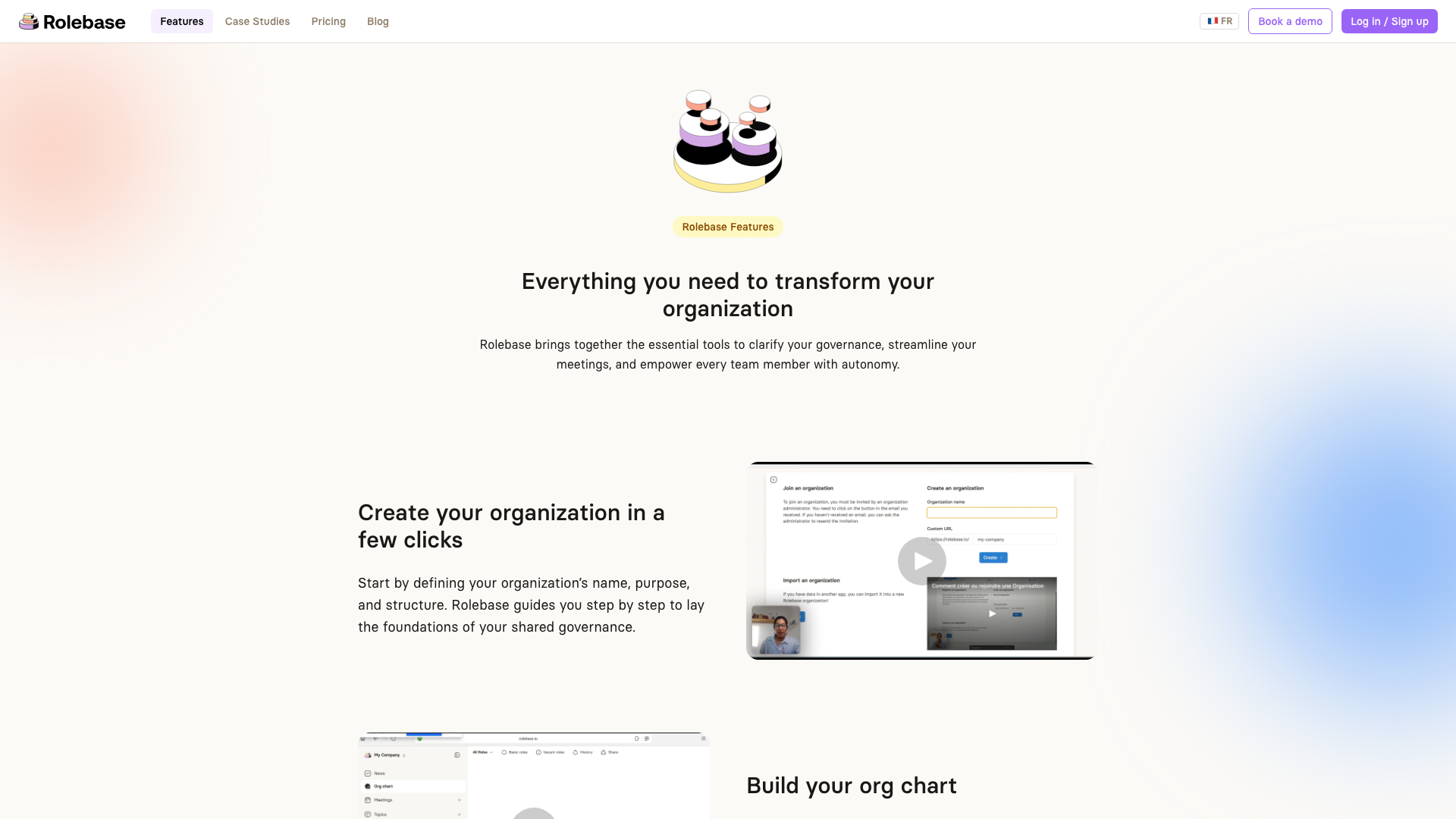
Rolebase gives you the mechanics without asking you to ratify anything. Every role carries its purpose, domain, accountabilities, checklist and metrics, and any role containing other roles behaves as a holacratic circle.
The "Represents its parent role (link)" option maps the constitutional link onto the org chart. A role marked that way turns whoever fills it into the representatives of the parent role, and those people become its leaders for permission purposes.
The governance mode decides who may touch the org chart. In Free mode every member edits. In Agile mode a role's leader edits the roles it contains and assigns members to them. In Strict mode every structural change goes through a proposal, which bundles the decision put to a vote with the org chart changes prepared in advance and applied once the vote passes. Strict mode is the one that sits closest to article 5.2.
Base roles cover the four constitutional roles. Create Circle Lead, Circle Rep, facilitator and secretary once, then reuse them in several places on the org chart. Editing a base role updates every place it appears, and only organization owners may edit one, which keeps a single team from silently changing a definition used elsewhere. A role that diverges can be separated from its base afterwards.
Our implementation guide walks through the eight steps, from governance settings to proposals. See what Rolebase does, or start your organization free for up to five active members.
Frequently asked questions
What is the difference between Lead Link and Circle Lead?
They are two names for the same role. Version 5.0 of the Holacracy constitution, published in June 2021, replaced Lead Link with Circle Lead and Rep Link with Circle Rep. The substance changed too. The six accountabilities and the domain that Appendix A of version 4.1 attached to the Lead Link are gone, replaced by a single rule: the Circle Lead Role holds the purpose of the broader role containing it, plus whichever of that role's accountabilities no other role in the circle covers.
Is the Circle Lead a manager?
The role keeps two managerial powers and loses three. It assigns people to the circle's roles and resolves priority conflicts across them. How the work gets done belongs to each Role Lead under article 4, the structure of roles changes in a governance meeting where the Circle Lead holds one voice, and pay and contracts fall outside the constitution entirely.
Who appoints the Circle Lead?
The Circle Lead one level up. Filling a role makes you the Circle Lead of the circle inside that role, and article 1.4.1 reserves assignments to the Circle Lead of the circle where the role lives. The appointment therefore descends from the anchor circle, unlike the Circle Rep, facilitator and secretary, who are elected by the circle itself.
Can a circle have several Circle Leads?
Yes. Article 1.4.1 allows the same role to be assigned to several people at once, and each of them becomes a Circle Lead of the inner circle. Article 5.3.6 anticipates this by naming the first of them to declare themselves when a surrogate facilitator or secretary is needed.
Can a Circle Lead remove someone from a role?
Yes, at any time, unless the circle adopted a policy constraining that power or moving it to another role. Article 1.4.1 states it explicitly. The person keeps their other roles and their place in the organization, since the constitution covers neither employment contracts nor compensation.
What is the difference between Circle Lead and Circle Rep?
The Circle Lead comes down from the broader circle and carries the purpose of the role into the circle. The Circle Rep goes the other way, with a purpose of "Tensions relevant to process in a broader Circle channeled out and resolved". Article 5.1.1 forbids holding both in the same circle, which keeps the upward channel independent.
Can a Circle Lead be elected facilitator?
Yes, since version 5.0. Version 4.1 barred the Lead Link from being elected facilitator or Rep Link. Version 5.0 keeps only the Circle Rep exclusion, and article 5.1.2 opens facilitator and secretary elections to every circle member unless a policy narrows the field.
What to take away
The Circle Lead holds real and narrow authority. Assign roles, resolve priority conflicts, cover vacant roles, and the constitution stops there. The rest of what a manager used to hold splits between the Role Lead, who decides how the work happens, and the governance process, which decides the structure.
The question worth asking before appointing anyone is about the two articles that let a circle take authority back, 1.4.5 and 5.1.1. A circle that leaves them dormant kept its manager and changed the label.


