
How to Create an Org Chart for Your Company!
Build a readable org chart in a few clicks, share it with your team and keep it accurate as roles change. The free options are compared here.
August 9, 2023
Updated on September 13, 2026
In the ever-evolving business world, it is essential for companies to stay organized and well-structured. An effective way to achieve this is to create an org chart, also known as an organizational chart. An org chart is a visual representation of the company's structure, showing the different hierarchical levels, functional relationships, and the roles and responsibilities of each employee. In this article, we will explore the importance of an org chart for your company and the steps needed to create an effective one.
Understanding the Importance of an Org Chart
Before diving into the details, it is crucial to understand why your company needs an org chart. An org chart provides a clear overview of your company's organizational structure, allowing employees to understand how they fit into the system and how their contributions help achieve company goals. Here are a few reasons why an org chart is so important:
Why does your company need an org chart?
An org chart allows you to visualize the hierarchy and the functions of each member of the company, which facilitates communication and collaboration. It also provides a clear structure for career development, allowing employees to understand opportunities for promotion and growth. Additionally, an org chart helps maximize operational efficiency by distributing responsibilities in a balanced way and avoiding duplication of effort.
The benefits of a well-structured org chart
A well-structured org chart offers many benefits. First, it clarifies responsibilities and makes employees more accountable for their tasks. It also establishes clear lines of communication, which improves coordination and reduces interdepartmental conflicts. Moreover, a well-designed org chart helps new employees acclimate more quickly to the company by providing a detailed overview of the organization's structure. Finally, it facilitates decision-making and resource allocation by quickly identifying the right people for each task.
Another benefit of a well-structured org chart is that it helps manage company growth more effectively. As your company expands, having a clear organizational structure is essential to avoid confusion and disorder. An org chart allows you to see how each department or team fits into the company as a whole, making it easier to manage resources and projects.
Furthermore, a well-designed org chart promotes transparency within the company. By clearly displaying the hierarchy and responsibilities of each team member, you create a work environment where everyone knows what is expected of them. This fosters trust and collaboration, as employees know who to turn to for answers or to resolve issues.
Finally, an org chart can also be a valuable tool for planning and decision-making processes. By understanding your company's organizational structure, you can identify gaps or weak points that may need special attention. This allows you to put strategies and corrective actions in place to improve the efficiency and productivity of your company.
Key Elements of an Org Chart
Now that you understand the importance of an org chart, it is time to examine the key elements that make one up. An effective org chart should include two main elements:
Defining roles and responsibilities
Each member of your company should have a well-defined role and clear responsibilities. A well-structured org chart should reflect this by indicating the different positions and specifying the tasks and functions of each employee. This helps reduce misunderstandings and improve productivity by avoiding overlaps and responsibility conflicts.
For example, in a furniture manufacturing company, the org chart might show that the workshop manager is responsible for overseeing production, while the purchasing manager is in charge of sourcing quality materials. Each employee then knows exactly what their responsibilities are and who they report to.
Identifying hierarchical relationships
Another key element of an effective org chart is identifying hierarchical relationships. This means clearly indicating management levels and the reporting lines between the different positions in the company. This allows employees to understand their place in the chain of command and know who they report to.
Let's take the example of a marketing company. The org chart might show that the CEO is at the top of the hierarchy, followed by the directors of the marketing, sales, and communications departments. Each department is then made up of team leaders and staff members. This clear hierarchical structure allows each employee to know their direct supervisor and who to contact when needed.
In summary, a well-designed org chart should define the roles and responsibilities of each member of the company, as well as the hierarchical relationships between the different positions. This promotes clarity, communication, and productivity within the organization.
Steps to Create an Effective Org Chart
Creating an effective org chart for your company is a process that involves several steps. Follow these steps to create an org chart that meets your company's needs:
Gather the necessary information
The first step to creating an effective org chart is to gather all the necessary information. This includes the names and functions of each employee, as well as information about existing hierarchical relationships. You can use questionnaires or individual interviews to collect this information in an organized way.
To gather the necessary information, it is important to consider all departments in your company. Make sure to collect information from each team, including both full-time and part-time employees. This will ensure that your org chart is complete and accurately reflects your company's organizational structure.
Choose the appropriate org chart format
Once you have the information, choose the type of org chart. Each type of org chart answers a different question: a hierarchical tree shows who reports to whom, a functional org chart which department does which work, a matrix org chart who works for two managers, and a circle org chart which team sits inside which. Pick the one that answers the question your teams ask most often, then check that it matches how your company actually works. In Rolebase, you can display your roles as circles, a hierarchical tree or a photo directory, and switch from one view to another without redrawing anything.
Draw the org chart
The final step is to draw the org chart. You can use specialized org chart creation tools or graphic design software to do this. Make sure your org chart is clear, clean, and easy to understand. Use shapes and colors to distinguish different hierarchical levels and functions.
When drawing your org chart, take the time to think about the layout of elements. Make sure hierarchical relationships are clearly represented and that connections between different departments are visually obvious. Feel free to ask for feedback from your colleagues or other team members to ensure your org chart is easily understandable by everyone.
In conclusion, creating an effective org chart for your company requires gathering the right information, choosing the right format, and carefully drawing the org chart. Follow these steps and you will have a valuable tool for visualizing your company's structure and facilitating internal communication.
Using Org Chart Creation Tools
Creating an effective org chart often requires the use of specialized tools. Here are some popular tools you can use:
General-purpose tools
You can create an org chart with Word, Whimsical, Figma, any graphical tool, or within certain HR software. Drawing an org chart in Word with SmartArt takes about ten minutes, or less from a template you download. However, the result will not be interactive and updating it will often be centralized to a single person. This creates a barrier to adoption by your teams.
Specialized tool
Rolebase was designed as the tool that makes Role Based Management easy, with the org chart and roles within your organization as its cornerstone.
Define a purpose, a domain, indicators, and accountabilities.
Software engi-what? Thanks to these different elements, each team member can understand the role of a position or a team.
We do not want to overload your managers. Our AI features allow them to save valuable time when describing the different functions within your company.
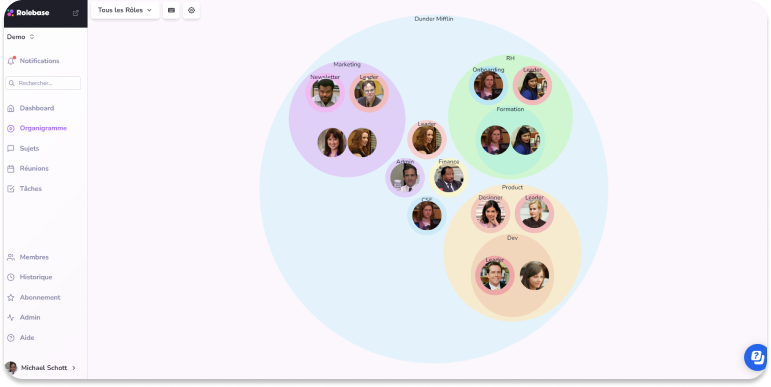
Org chart created with Rolebase
Maintaining and Updating Your Org Chart
An org chart is not a static document, but rather an evolving tool that must be maintained and updated regularly. Here are some tips for keeping your org chart up to date:
When and how to update your org chart
Update your org chart whenever there are significant changes in the company's structure, such as promotions, departures, or new hires. Make sure to communicate these changes to all affected employees and update the org chart on the company's internal communication channels.
Managing changes in the org chart
When making changes to your org chart, make sure to consider the implications on roles, responsibilities, and team dynamics. Clearly communicate these changes to company members and provide them with the necessary support to adapt to new structures or new responsibilities.
In conclusion, a well-designed org chart can improve the efficiency and productivity of your company by clarifying responsibilities, promoting communication, and facilitating decision-making. Follow the steps described in this article to create and maintain an effective org chart for your company. With a clear and up-to-date org chart, your employees will have a better understanding of their role and their contribution to the company's success.
Create your org chart for free today
You can create your dynamic org chart for free with Rolebase!
It could not be simpler: just create your company workspace and in a few clicks you will bring it to life.


